
Do Ice Baths Help MMA Recovery? What the Data Shows
Do ice baths help MMA recovery? Compare small fighter trials, a 52-study review, muscle-growth tradeoffs, and what cold plunges cannot prove.
Quick answer
Ice baths can help MMA fighters feel less sore after hard training. Evidence for better performance is narrower, and timing matters. A small MMA trial found slower sprints immediately after cold immersion, but a possible benefit the next day. A larger review supports modest recovery benefits after intense exercise. Regular ice baths straight after lifting may also reduce muscle growth. Use cold water for a specific recovery goal, rather than assuming that feeling fresher means you're getting stronger or becoming harder to beat.
Data snapshot: Published evidence reviewed through October 24, 2026. MMA trials included 12 men in 2018 and 16 athletes in 2026. Reviews covered 52 recovery studies in 2022 and 8 muscle-growth studies in 2024. These samples overlap and aren't added together.
Why do UFC fighters use ice baths?
Fighters want relief from training soreness, but celebrity use doesn't establish what a treatment achieves. That distinction matters when a recovery habit becomes a highlight clip.
In July 2024, Israel Adesanya requested backstage ice baths after post-fight doctor checks, as reported by The SportsRush. UFC's 2023 TUF recap documents Conor McGregor and Michael Chandler taking part in cold-plunge trivia.
Those examples show interest and exposure, not controlled recovery tests. Adesanya's request poses a useful question about comfort after fighting. McGregor and Chandler's challenge says little about how to prepare for training tomorrow.
You need to separate three goals: reducing soreness, restoring performance, and improving fitness over a training block. An ice bath can help one without helping the others.
What do studies on MMA athletes actually show?
The direct MMA evidence is small, and its strongest message concerns how athletes feel. It doesn't show that cold-water immersion improves UFC win rates.
Montassar Tabben and colleagues studied 12 trained male MMA athletes in 2018. Each athlete completed both recovery conditions, following simulated bouts with three five-minute rounds. This crossover design helps limit differences between participants.
The cold condition involved 15 minutes of lower-body immersion at about 10°C. The comparison involved sitting at room temperature. Researchers tested jumps, short sprints, blood markers, and self-reported wellness.
Immediately after immersion, sprint performance was worse. At 24 hours, the authors reported a possible benefit for the 10-m sprint, alongside better wellness scores. The 5-m sprint and jump tests didn't show the same next-day benefit.
That positive sprint result needs care. The authors used magnitude-based inference, and the reported uncertainty interval included no effect. Treat it as a promising signal, not a settled performance gain.
Behnam Boobani and colleagues added a Polish pilot study in 2026. It included 16 MMA athletes, with only four assigned to each recovery method. The methods were cold-water immersion, cryosauna, foam rolling, and passive rest.
Across two weeks, jump performance improved over time, but differences between recovery groups weren't statistically significant. The trial didn't establish that cold water caused the jump improvement.
| Evidence | Sample and scope | Main finding | What you cannot conclude |
|---|---|---|---|
| Tabben, 2018 | 12 male MMA athletes; simulated bouts | Better reported wellness; possible 10-m sprint benefit at 24 hours; slower sprints immediately afterward | Better performance across all tests or more fight wins |
| Boobani, 2026 | 16 MMA athletes; four per group; two weeks | No clear difference between recovery groups in jump improvement | Cold water beats the other recovery methods |
| Moore, 2022 | 52 exercise-recovery studies | Small next-day power benefits; less soreness after high-intensity exercise | Every athlete or every training session benefits |
| Piñero, 2024 | 8 resistance-training studies; 4–12 weeks | Immediate post-lifting immersion may reduce muscle growth | Occasional ice baths erase strength or muscle |
The table compares different questions. It isn't a ranking of methods, and the reviews aren't extra pools of UFC fighters.
Does broader research support ice baths for MMA recovery?
The wider evidence supports some short-term benefits, especially after high-intensity exercise. It still doesn't justify treating every recovery measure as interchangeable.
Emma Moore and colleagues' 2022 review combined 52 studies comparing cold-water immersion with passive recovery. At 24 hours, the pooled results favored cold water for muscular power after high-intensity exercise. Soreness and perceived recovery also improved.
Strength recovery didn't show a statistically significant benefit. That matters if your goal is restoring force for lifting or grappling. Better jump-related power doesn't automatically mean a stronger grip or better takedowns.
The comparison also matters. Beating passive rest doesn't establish that cold water beats a well-managed training schedule or another active recovery method. Those require direct comparisons.
Blood tests need the same restraint. A change in a muscle-damage marker doesn't tell you whether a fighter can defend combinations or maintain sound decisions.
For Adesanya's recovery question, less soreness could have value on its own. Claiming improved fight performance would require evidence that these studies don't provide.
Can ice baths reduce muscle growth after lifting?
Regular cold immersion immediately after resistance training may reduce the muscle growth you get from that training. This is the main tradeoff hidden by the word recovery.
Alec Piñero and colleagues examined 8 studies in their 2024 review. The training periods lasted 4–12 weeks. Participants were young adults, and seven studies included only men.
The pooled comparison favored resistance training without immediate cold immersion for muscle growth. The estimate was uncertain, and the authors rated the underlying evidence as generally fair to poor.
So the sensible reading is cautious. Repeated post-lifting cooling may blunt some adaptation. The review doesn't show that one ice bath destroys progress, or that every fighter must avoid cold water.
It also doesn't establish a precise waiting period that removes the tradeoff. Claims that you can protect all gains by waiting a fixed number of hours go beyond this evidence.
Your goal changes the decision. During a strength-building phase, protecting training adaptation may matter more than reducing ordinary soreness. During a crowded training schedule, short-term readiness may carry more weight.
That's a practical inference from the competing outcomes, not a tested formula for winning fights. Muscle size, strength, conditioning, and MMA skill are different outcomes.
When might an ice bath fit an MMA training plan?
Start with the next session and the purpose of today's work. The same recovery habit won't suit every part of camp.
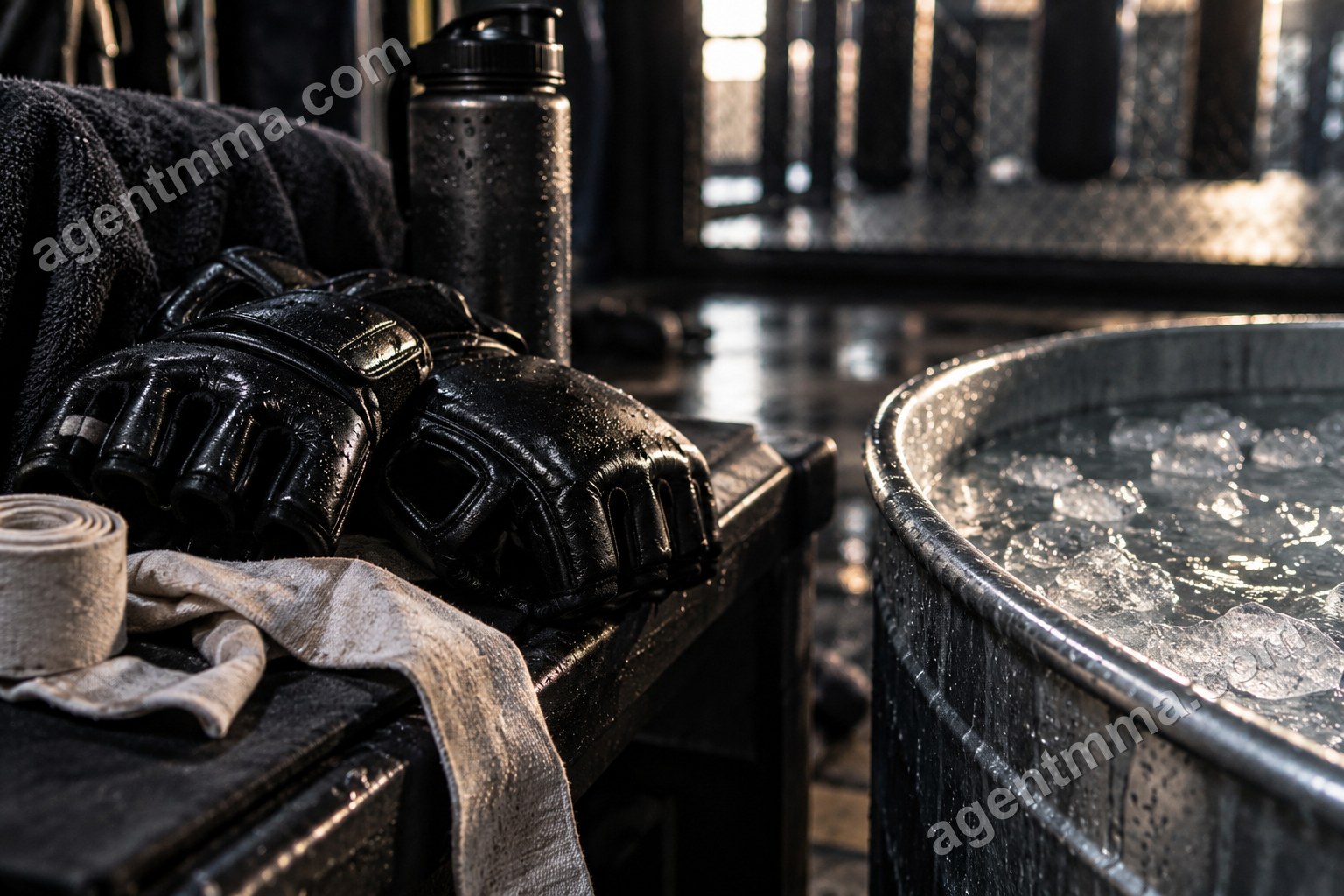
- After demanding conditioning, cold immersion may help soreness and next-day readiness. Track whether the next session actually improves.
- After lifting aimed at muscle growth, avoid making immediate immersion automatic. The adaptation evidence gives you a reason to reconsider that habit.
- Before another explosive session soon afterward, don't assume that cold legs are ready legs. The small MMA trial found slower immediate sprints.
- After a fight, recovery measures don't replace medical assessment. The exercise studies didn't test clearance to return after injury.
These are choices to discuss with your coach and medical team. They aren't a universal cold-plunge schedule, and they don't establish that every athlete needs a tub.
How cold and how long should an MMA ice bath be?
The MMA trials don't identify one best temperature or duration. Tabben's 15-minute, roughly 10°C protocol describes what researchers tested; it isn't a prescription for you.
Immersion depth also matters when comparing research. Cooling the legs differs from immersing most of the body. A cold shower or cryosauna isn't automatically an equivalent treatment.
Don't turn McGregor and Chandler's televised challenge into a recovery target. Tolerating discomfort doesn't measure the benefit you're getting.
The US National Weather Service warns that sudden cold immersion can trigger gasping, rapid breathing, and cardiovascular strain. More cold isn't automatically more useful.
Keep safety separate from effectiveness. A recovery trial cannot establish a safe personal protocol for someone with a medical condition or a fresh fight injury.
How can you tell whether it helps your training?
Judge the next session, not just the feeling when you leave the bath. A simple training log can keep those outcomes separate.
Record the session type, soreness, sleep, and one repeatable performance measure your coach already uses. Note whether you used cold immersion and when. Keep the test and training context as consistent as practical.
Look for repeated patterns across comparable sessions. Don't credit the bath for a good day after lighter training or better sleep.
This won't create a clinical trial. It can still stop you confusing a pleasant ritual with a useful change in performance. Report feeling better as feeling better.
How solid is this data?
This article synthesizes published studies; it isn't an AgentMMA fight-outcome analysis. The direct MMA trials involve small groups, simulated competition, or short training blocks.
Tabben's participants were men, and its performance inference remains uncertain. Boobani's four athletes per group leave little room for stable comparisons. Neither trial represents the full range of UFC athletes.
Blinding is another problem: you know whether you're sitting in cold water. Expectations can influence soreness and wellness ratings, even when those feelings matter to you.
The larger reviews cover varied exercises and protocols. Some underlying studies overlap with the direct evidence, so their sample sizes cannot simply be added together.
None of the cited trials establishes fewer injuries, better concussion recovery, or more UFC victories. Those claims need their own evidence.
FAQ
Do ice baths help MMA fighters recover faster?
They can reduce soreness and improve perceived recovery after hard exercise. Evidence for restored physical performance is more selective. A small MMA trial reported a possible next-day 10-m sprint benefit, but not improvements across every test.
Should you take an ice bath before or after MMA training?
The evidence discussed here concerns recovery after exercise. Immediate cooling slowed sprints in one small MMA trial. Don't assume that taking an ice bath before explosive work helps, or that immediate post-lifting use has no tradeoff.
Do ice baths stop muscle growth?
They don't necessarily stop it. A review of 8 studies found that repeated cold immersion immediately after lifting may reduce muscle growth. That finding doesn't prove that occasional use eliminates gains, and the evidence has quality limits.
How often should MMA fighters use ice baths?
There is no proven universal weekly schedule for MMA fighters. Frequency should reflect the training goal, response, and safety considerations. The cited evidence doesn't justify daily immersion for everyone or identify a guaranteed gap after lifting.
Sources & further reading
The data and published sources behind this article.
- Tabben et al. (2018): MMA cold-water recovery trial (pmc.ncbi.nlm.nih.gov)
- Boobani et al. (2026): Polish MMA recovery pilot (www.mdpi.com)
- Moore et al. (2022): 52-study cold-water recovery review (link.springer.com)
- Piñero et al. (2024): Throwing cold water on muscle growth (pmc.ncbi.nlm.nih.gov)
- The SportsRush: Adesanya requests post-fight ice baths (thesportsrush.com)
- UFC: Episode 11 Recap | The Ultimate Fighter Season 31 (www.ufc.com)
- US National Weather Service: Cold Water Hazards and Safety (www.weather.gov)
Put the data to work
Compare any two fighters head-to-head, or see what our AI predicts for upcoming UFC fights.