
How Common Are UFC Eye Pokes? Rules, Data and Outcomes
How common are UFC eye pokes? A 397-fight audit, current recovery rules, and real no-contest, technical-decision, and disqualification outcomes.

Quick answer
The best public estimates put an eye poke in roughly 7-8% of major MMA fights. A 2022 audit found at least one poke in 31 of 397 UFC, Bellator, and PFL bouts. UFC separately reported about one incident per 14 fights. Most don't end the bout. The referee can pause the action and allow up to five minutes of recovery. An early accidental stoppage usually becomes a no contest. A later one can reach the scorecards, while an intentional foul can cause a disqualification.
Data snapshot: a January-June 2022 audit covered 397 UFC, Bellator, and PFL fights and logged 36 pokes in 31 bouts; a separate Nevada study covered 2,208 professional MMA fights from 2001-2020 and measured all eye injuries, not pokes alone.
How common are eye pokes in UFC fights?
The most useful public audit covered fights from January 1 through June 30, 2022. Ringside physician John Neidecker's team reviewed 256 UFC bouts, 89 Bellator bouts, and 52 PFL bouts.
The team logged 36 pokes across 31 of 397 fights. Our calculation puts the affected-fight rate at 7.8%, or one in 12.8 bouts. The average pause was 36 seconds.
| Measure | Scope | Result |
|---|---|---|
| Fights with a recorded eye poke | UFC, Bellator, PFL; first half of 2022 | 31 of 397 (7.8%) |
| Recorded eye-poke incidents | Same 397 fights | 36 |
| Average pause | Poke delays in that audit | 36 seconds |
| UFC's internal summary | UFC; period not published | One per 14 fights |
The UFC-specific estimate points in the same range. Duncan French of the UFC Performance Institute said the promotion found about one poke per 14 fights. He put the average delay near 50 seconds.
That second figure works out to about 7.1 incidents per 100 fights. Treat it as a company estimate. UFC hasn't published the underlying bout list, counting method, or confidence range.
Fight-ending eye pokes are much rarer. ESPN Stats & Information found seven UFC bouts ending as no contests from eye pokes between 2005 and October 2019. That count is now historical, not current. Later examples include Tom Aspinall's 2025 title fight with Ciryl Gane.
What counts as an eye-poke foul?
The 2025 Unified Rules ban eye gouging with fingers, the chin, or an elbow. A legal punch that lands around the eye socket is not automatically a gouge.
The rules act before contact, too. In a standing exchange, moving an open hand toward an opponent's face with fingers pointing forward is itself a foul. Fighters should close the fist or point their fingers upward.
That detail often gets lost on broadcasts. The referee doesn't need to wait until a fingertip enters an eye before warning or penalizing the action.
Open hands remain part of MMA. Fighters use them to frame, parry, hand-fight, and prepare takedowns. The rule targets the direction of the fingers near the face, not every open hand.
How much recovery time does a fighter get?
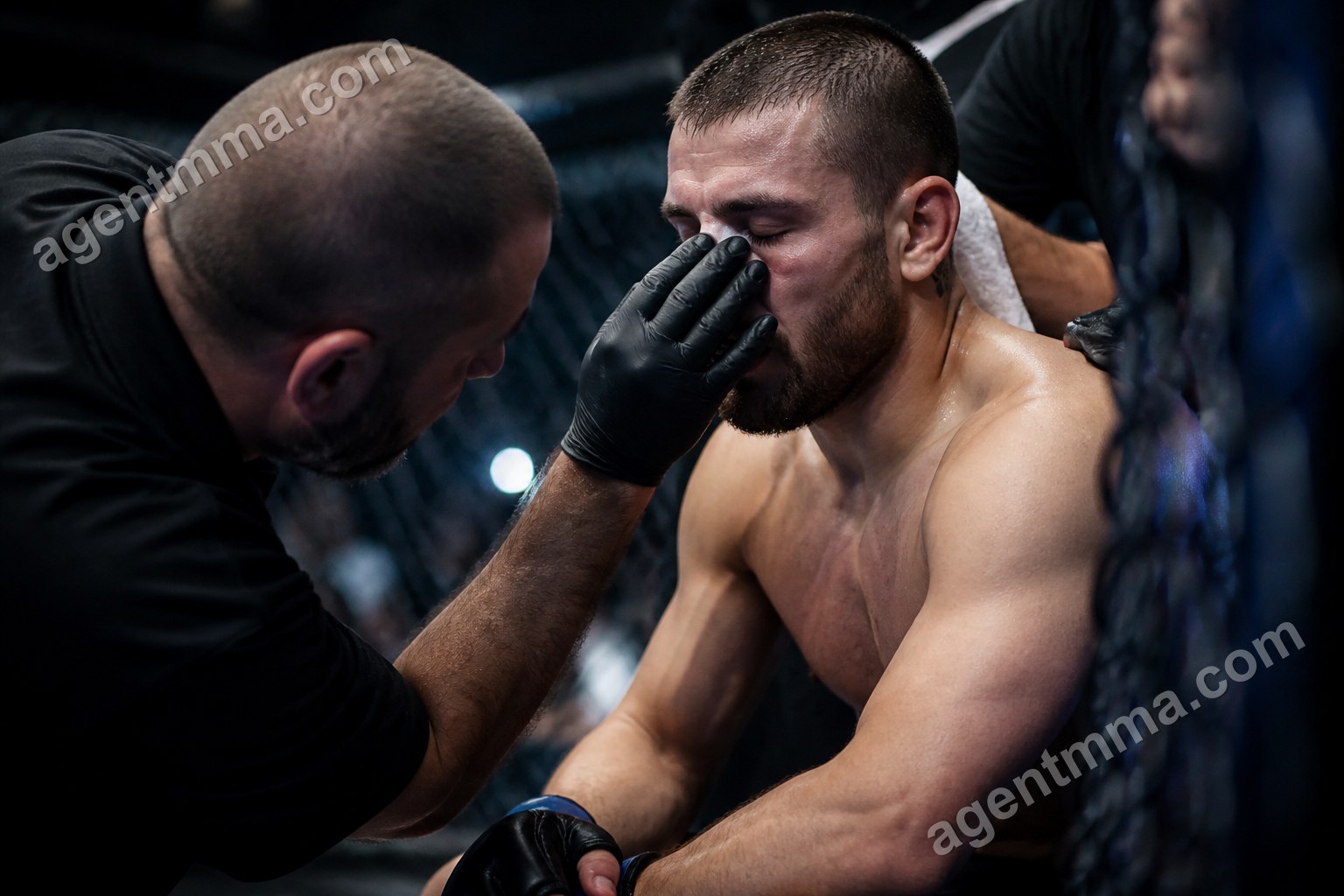
A fighter may receive up to five minutes after an eye poke if they can potentially continue. It isn't an automatic five-minute break on demand.
The referee first calls time and checks the fighter's condition. The ringside physician may examine the eye at any point. The current rules also allow a cold compress or wet towel while the fighter composes themselves.
The fighter then needs to say whether they can see. The doctor and referee still control the safety decision. Corners can't coach during the timeout.
The procedure is meant to answer one question: can the fighter safely resume? It isn't meant to test toughness. An eye can look normal from a distance while vision remains blurred or doubled.
What result follows a UFC eye poke?
Timing and intent change the official outcome. The exact ruling also belongs to the referee and the commission sanctioning the event.
| Situation under the Unified Rules | Likely official result |
|---|---|
| Fighter recovers and can continue | Bout resumes; the referee may warn or deduct points |
| Accidental foul stops a three-round bout before two rounds finish | Usually a no contest |
| Accidental foul stops a five-round bout before three rounds finish | Usually a no contest |
| Accidental foul stops the bout after the required rounds | Technical decision for the fighter ahead on the scorecards |
| Intentional foul causes an immediate fight-ending injury | Disqualification loss for the offending fighter |
| Intentional foul injures the opponent, but the bout continues | Mandatory two-point deduction under the 2025 rules |
This table is a guide, not a remote referee. A commission can review how the foul was classified. The official rules also cover technical draws and later stoppages tied to an intentional-foul injury.
The key split is early versus late. Before enough rounds are complete, there aren't enough scorecards to decide an accidental-foul stoppage. After two rounds of a three-round fight, or three of a five-round fight, the judges can decide it.
Why was Aspinall vs Gane a no contest?
Tom Aspinall's heavyweight title defense against Ciryl Gane ended at 4:35 of Round 1 on October 25, 2025. Gane's fingers struck Aspinall's eyes during an exchange. Aspinall couldn't continue, and the referee ruled the bout a no contest.
The timing explains the verdict. Only the first round was underway, far short of the three completed rounds needed for scorecards in a five-round fight. The foul was ruled accidental, so Gane wasn't disqualified.
Aspinall kept the title because a no contest gives neither fighter a win. The stoppage also shows why a fighter's ability to continue shouldn't be judged from slow-motion footage alone.
This case doesn't tell us whether every similar hand position receives the right warning. It shows how the written early-stoppage rule works in a real title fight.
Why did Song Yadong beat Henry Cejudo after an eye poke?
Song Yadong and Henry Cejudo reached a different result on February 22, 2025. Their five-round main event stopped after three completed rounds because Cejudo couldn't continue following an accidental eye poke.
Enough rounds had finished, so the judges' scores were used. Song won a unanimous technical decision with cards of 29-28, 29-28, and 30-27.
The contrast with Aspinall-Gane is clean. Both stoppages followed accidental eye pokes. Aspinall-Gane ended too early for cards, while Song-Cejudo crossed the five-round timing threshold.
A technical decision doesn't mean judges score the foul as effective offense. They score the completed fight action, then the commission applies the foul procedure.
Do eye pokes always cause a point deduction?
No. Accidental eye contact doesn't produce an automatic point deduction under the Unified Rules. The referee assesses the foul, its effect, prior warnings, and whether the conduct was intentional.
The 2025 rules are firmer on intentional fouls. If an intentional foul injures the opponent but the fight continues, two points must be deducted. If that injury ends the fight immediately, the offender loses by disqualification.
Warnings still matter because the forward-finger position is already prohibited. A referee can tell a fighter to close the fist or point the fingers upward before contact occurs.
Fans often ask for automatic deductions after every poke. That policy may sound simple, but the current rules don't create it. Accidental contact, unseen contact, and disputed contact still require referee judgment.
Did the UFC redesign its gloves to prevent eye pokes?
Yes. UFC introduced redesigned gloves at UFC 302 in June 2024. The changes included padding meant to help the hand rest in a more natural position and reduce forward-pointing fingers.
The trial lasted about six months. UFC returned to its previous glove design for UFC 309 in November 2024 after fighters complained about the new gloves' fit and feel. The Associated Press reported that the switch back appeared permanent at the time.
There is no public controlled study showing that the short trial reduced eye pokes. You can't judge the design from a few memorable cards. Event mix, fighter behavior, enforcement, and random variation can swamp a small sample.
Gloves also face a hard design tradeoff. MMA athletes need finger movement for grappling, unlike boxers. A glove can encourage a curved hand without fully preventing a fighter from extending the fingers.
What does medical research say about MMA eye injuries?
A 2021 peer-reviewed study used Nevada Athletic Commission records from 2001 through 2020. It covered 2,208 professional MMA fights across 256 events. Researchers found 369 eye injuries in 363 fighters.
The injury mix looked like this:
| Recorded eye injury | Cases | Share of 369 injuries |
|---|---|---|
| Eyebrow or eyelid laceration | 160 | 43% |
| Laceration around the eye | 98 | 27% |
| Orbital fracture | 62 | 17% |
These aren't 369 eye pokes. Most listed injuries can follow legal strikes. The study tracked medical diagnoses in professional MMA, not foul calls in UFC bouts.
That distinction blocks a tempting but false calculation. Dividing 369 by 2,208 doesn't estimate the UFC eye-poke rate. It estimates recorded eye injuries within one state's broader MMA data, under that study's methods.
Researchers also found that 228 injured fighters, or 62.8%, lost their bouts. That association doesn't prove the injury caused the loss. Legal damage, fight outcome, and medical reporting all overlap.
How solid is this data?
The one-in-14 estimate is useful because it comes from UFC's own performance staff and concerns UFC bouts. Its weakness is transparency. The public can't inspect the incidents or repeat the count.
The Nevada study has a clear period, sample, and medical source. Yet it combines promotions and every recorded eye injury. It can't isolate fingers, UFC gloves, or referee enforcement.
The no-contest count from ESPN stops in 2019. It proves that fight-ending eye pokes occurred, not their current rate. Aspinall-Gane and Song-Cejudo show the modern rules in practice, but two cases can't measure frequency.
Rule adoption can also vary by jurisdiction. The 2025 Unified Rules are the best baseline, while the local commission remains the authority for each event. Check the event's official result before classifying a disputed stoppage.
FAQ
Are eye pokes illegal in the UFC?
Yes. Eye gouging is illegal, and the Unified Rules also ban pointing outstretched fingers toward an opponent's face during standing exchanges.
Does a UFC fighter get five minutes after an eye poke?
A fighter may get up to five minutes if they can potentially continue. The referee and ringside physician can examine the eye and stop the bout sooner for safety.
Is an accidental eye poke a disqualification?
Usually not. An early fight-ending accidental eye poke normally produces a no contest. An intentional or flagrant foul can produce a disqualification.
When does an eye poke go to the scorecards?
An accidental-foul stoppage can reach the scorecards after two rounds of a three-round bout or three rounds of a five-round bout are completed.
Why don't UFC gloves fully prevent eye pokes?
MMA gloves must leave fingers mobile for grappling. A curved design may discourage extension, but it can't remove finger movement or replace rule enforcement.
Sources & further reading
Peer-reviewed studies and primary data behind this analysis.
- ABC: Unified Rules of MMA (2025) (www.abcboxing.com)
- AP via Sportsnet: eye-poke audit and UFC estimate (www.sportsnet.ca)
- AP: UFC returned to previous gloves (apnews.com)
- Clinical Ophthalmology: MMA eye-injury study (pubmed.ncbi.nlm.nih.gov)
- ESPN: UFC eye-poke investigation (www.espn.com)
- Reuters: Aspinall vs Gane no contest (www.reuters.com)
- UFC: Song vs Cejudo technical decision (www.ufc.com)
Put the data to work
Compare any two fighters head-to-head, or see what our AI predicts for upcoming UFC fights.
More from the MMA Lab

What Is a UFC Corner Stoppage? Towel and TKO Rules
A UFC corner stoppage ends as a TKO when a fighter’s team asks the referee to stop. See the towel rule, timing, rare cases, and record impact.

UFC Low Blow Rules: Five-Minute Recovery Explained
UFC low blow rules give a fouled fighter up to five minutes. Learn when referees warn, deduct points, rule a no contest or disqualify the offender.

Are Knees to the Head Legal in UFC? Rules Explained
The UFC illegal knee rule depends on whether the opponent is grounded. Learn what positions count, which knees are legal, and how fouls affect results.

Are Back-of-the-Head Strikes Legal in the UFC? Rule Explained
UFC back-of-head strikes are illegal, but the banned target is narrower than many fans think. See the exact zone, foul penalties and real examples.