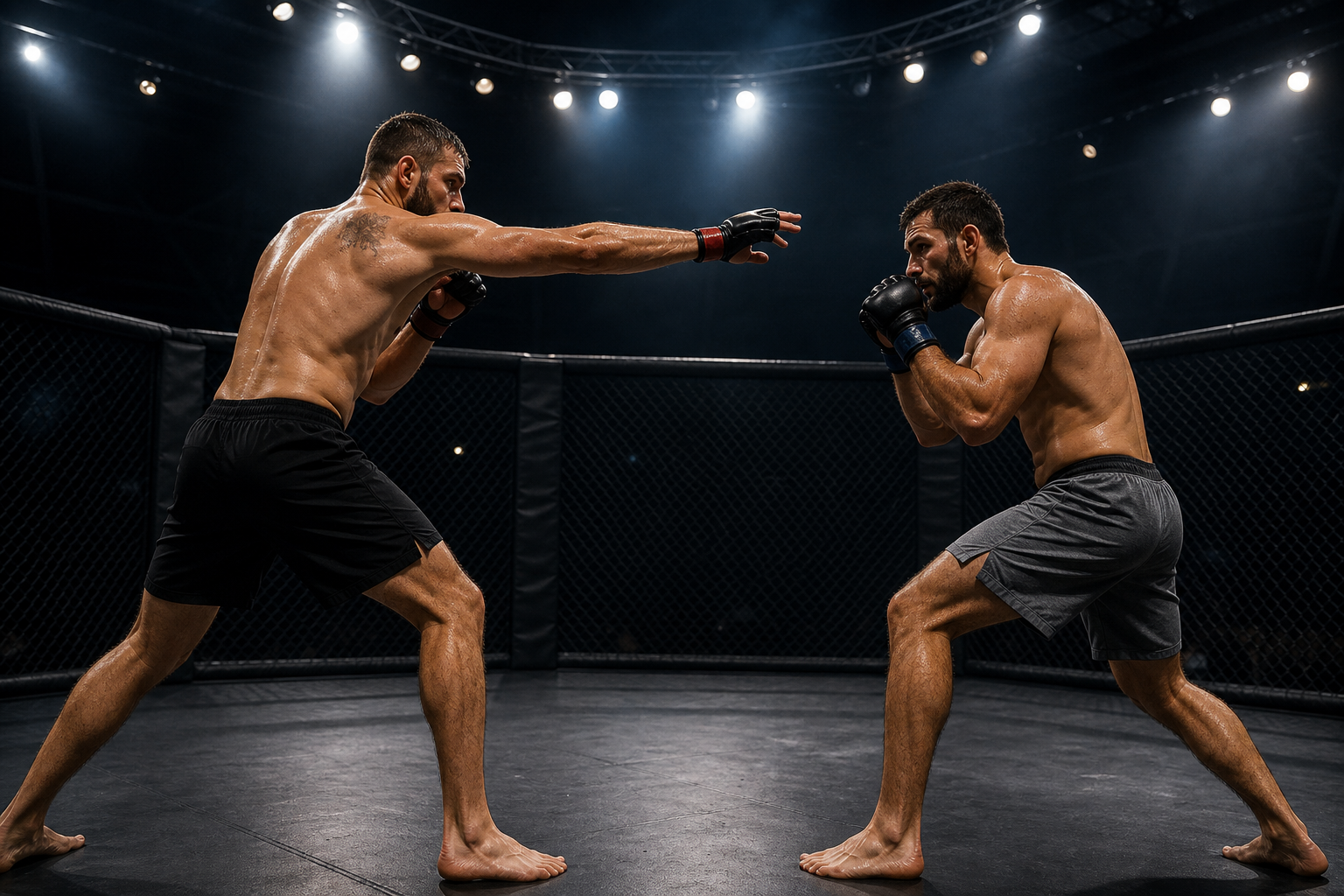
Volkanovski vs Evloev Reach: Does One Inch Matter at UFC 333?
Volkanovski vs Evloev reach differs by one inch. See the UFC 333 measurements, a 258-bout featherweight study, and what the gap can actually tell you.


Quick answer
Movsar Evloev has a one-inch listed reach advantage over Alexander Volkanovski ahead of UFC 333. That gap alone doesn't support a confident prediction. UFC Stats lists them at 72 and 71 inches. UFC athlete pages list 72.5 and 71.5 inches, preserving the same difference. The relevant research is less decisive than either side might want: a 2,229-bout study found inconclusive reach results at featherweight. Treat length as a question to test against their tactics, not a ready-made edge. Volkanovski enters as the reigning featherweight champion.
Data snapshot: Measurements checked October 22, 2026; UFC 333 is scheduled for October 24 in Abu Dhabi. Christopher Kirk's study covers 2,229 UFC bouts from January 1, 2017, to October 2, 2021, including 258 men's featherweight bouts. AgentMMA's roster benchmark covers 321 featherweights with recorded reach.
What is the Volkanovski vs Evloev reach difference?
The difference is consistent even though the published measurements aren't identical. UFC Stats gives Volkanovski 71 inches and Evloev 72 inches. Each UFC athlete page adds half an inch to its fighter's figure. Both sources therefore show Evloev with one extra inch.
| Source or comparison | Alexander Volkanovski | Movsar Evloev | What it tells you |
|---|---|---|---|
| UFC Stats listed reach | 71 inches | 72 inches | Evloev leads by 1 inch |
| UFC athlete page reach | 71.5 inches | 72.5 inches | Evloev leads by 1 inch |
| Listed stance on UFC Stats | Orthodox | Orthodox | The listed matchup uses the same stance |
| AgentMMA featherweight roster mean | 70.4 inches | 70.4 inches | Both exceed the same 321-fighter benchmark |
The final row describes the comparison group, not another measurement of either fighter. AgentMMA's fighter database includes former fighters. Its division average isn't an active-roster average, a ranking, or a win rate.
For your own comparisons, use the same source on both sides. Mixing Volkanovski's UFC Stats number with Evloev's athlete-page number exaggerates the gap. Mixing the opposite pair shrinks it. Neither approach gives you a better measurement.
Does that extra inch predict the UFC 333 winner?
The research doesn't supply a reliable win probability for this specific gap. Kirk's paper, A 5-Year Analysis of Age, Stature and Armspan in Mixed Martial Arts, makes that distinction useful.
It includes 258 men's featherweight bouts. Winners averaged 180.4 cm of armspan; losers averaged 179.5 cm. Those averages look favorable to longer fighters, but the featherweight tests were inconclusive.
That means the evidence didn't clearly settle the comparison. It doesn't establish that reach has no effect. It also doesn't justify treating a small positive average as a proven advantage.
The heavyweight comparison was different. Across 181 bouts, winners averaged 198.4 cm, against 196.1 cm for losers. Kirk found evidence of an armspan advantage there, with a small effect.
You can't transfer that finding to featherweight just because both divisions use the same cage. The relevant division had its own analysis. It didn't produce the same conclusion.
There is another trap in those averages. They compare the measurements of winners and losers. They don't tell you how often a fighter with exactly one extra inch won.
To answer that narrower question, you would need the individual bout data and a stated grouping rule. You would also need enough similar matchups. This article doesn't invent that missing win rate.

Why can listed reach mislead a fight preview?
Reach describes armspan, not a measured punch delivered from a fighting stance. You shouldn't read one extra inch of wingspan as one extra inch on every jab.
Consider a hypothetical exchange. A fighter steps forward as the opponent retreats, then lands before the opponent can reset. The measurement hasn't changed. The distance has.
For this matchup, our tactical inference is that position deserves more attention than the small listed difference. Watch where each fighter starts an exchange. Then watch where each finishes it.
Volkanovski could have the shorter listed reach and still reach the target first. Evloev could have the longer listed reach and still need to close distance. Those are possible fight situations, not claims about how this bout will unfold.
A useful preview should explain the action that turns body dimensions into an advantage. If it can't name that action, the reach figure adds description without much explanation.
What should you watch when striking turns into wrestling?
In MMA Fighting's fight-week reporting, Volkanovski highlights Evloev's wrestling. Our interpretation: the key reach question concerns entries and exits, not an isolated jab contest.
For Evloev, examine whether a strike makes Volkanovski react before an attempted entry. If that reaction opens a route to the hips, the setup matters. Longer arms alone don't explain it.
For Volkanovski, examine whether he can strike and leave without giving up his position. Landing while moving toward the fence presents a different tactical question from landing while keeping open space.
These are viewing questions, not findings from a coded film study. We haven't counted their successful entries, defensive exits, or distance changes. Treating that unmeasured work as a statistic would overstate the evidence.
When reviewing footage, make your notes concrete:
- Record what happened before contact: a feint, a punch, or an unprepared approach.
- Note whether the defender had open space or the fence behind him.
- Separate a clean escape from an exchange that merely paused before another entry.
- Include failed attacks as well as successful ones.
The last point protects you from a highlight-reel sample. Selecting only successful moments makes almost any physical trait look decisive. A useful comparison must leave room for the same tactic to fail.
Can a division average tell you who is unusually long?
AgentMMA's fighter database puts average recorded featherweight reach at 70.4 inches across 321 fighters. That gives you a descriptive reference. It doesn't show where either headliner sits in the full distribution.
An average can't establish a percentile. You need the individual measurements, their spread, and a clear rule for which fighters count. Without those, calling either man exceptionally long goes beyond the supplied data.
Jon Jones offers a useful check on the logic. AgentMMA lists his reach at 84 inches. That is a different body profile, but it doesn't isolate what reach contributes to a fighter's success.
To make that claim, you would need to separate length from the rest of the fighter and the opponents faced. A memorable name can't do that statistical work.
For the UFC 333 headliners, compare their measurements against each other before comparing either with a division average. Their opponent is a specific person. The average is background context.

How should an analyst use reach in a prediction?
Keep the listed difference as an input, then test whether it adds useful information. Don't award a fixed probability bonus because a fighter appears longer on a graphic.
For a model, the practical test is whether reach improves predictions on later fights that weren't used during development. Compare otherwise similar models with and without the measurement. Report the difference, including a disappointing result.
A model might find that reach helps only alongside another feature. It might find no useful gain. Those are possibilities to test, not results we claim AgentMMA has established here.
For a reader, the equivalent is simpler. Ask what your prediction would be without knowing reach. Then identify the evidence that makes the measurement change your view.
Keep that reasoning separate from a betting decision. A reach comparison doesn't tell you whether an available price is fair. This article provides neither a betting edge nor a tested wager strategy.
How solid is this data?
The fight measurements are published listings, not measurements taken by AgentMMA. Their disagreement is visible even across UFC properties. We preserve each source's pair rather than choose whichever number supports a stronger story.
Kirk's research uses 2,229 bouts featuring 1,079 fighters. It excludes draws, disqualifications, and no contests. Catchweight contests form a separate group. The author checked repeated measurements for inconsistencies and corrected or removed conflicting entries.
That is stronger evidence than a list of memorable champions. It still describes selected UFC athletes in a historical period. It isn't a randomized experiment, and the same fighters appear more than once.
The 258-bout featherweight subset is the relevant sample here. Quoting the full total without that qualifier makes the division-specific evidence sound broader than it is.
Our matchup interpretation also remains separate from the paper. The study didn't test Volkanovski against Evloev at UFC 333. Nor does AgentMMA's roster average supply any fight outcomes.
FAQ
Who has the longer reach, Volkanovski or Evloev?
Evloev has the longer listed reach by one inch. UFC Stats lists 72 inches against Volkanovski's 71. UFC athlete pages list 72.5 and 71.5 inches, keeping the same gap.
Why do UFC reach measurements differ between websites?
Published listings can disagree, including UFC Stats and UFC athlete pages. The pages checked here don't explain the discrepancy. Compare both fighters within the same source and keep the source attached to the figures.
Does reach matter in UFC featherweight fights?
It may matter within a particular exchange, but the cited 258-bout featherweight analysis was inconclusive. That supports caution, not a claim that longer fighters always benefit or that reach never matters.
Is Volkanovski still champion going into UFC 333?
Yes. As of October 22, 2026, Alexander Volkanovski is the reigning UFC featherweight champion. He is scheduled to defend against Movsar Evloev in Abu Dhabi on October 24.
Sources & further reading
The data and published sources behind this article.
- UFC Stats: Volkanovski vs Evloev comparison (ufcstats.com)
- UFC: Alexander Volkanovski athlete profile (www.ufc.com)
- UFC: Movsar Evloev athlete profile (www.ufc.com)
- Kirk: A 5-Year Analysis of Age, Stature and Armspan in Mixed Martial Arts (shura.shu.ac.uk)
- UFC 333: Volkanovski vs Evloev (www.ufc.com)
- MMA Fighting: Volkanovski on Evloev’s wrestling (www.mmafighting.com)
- AgentMMA fighter database (agentmma.com)
Put the data to work
Compare any two fighters head-to-head, or see what our AI predicts for upcoming UFC fights.