
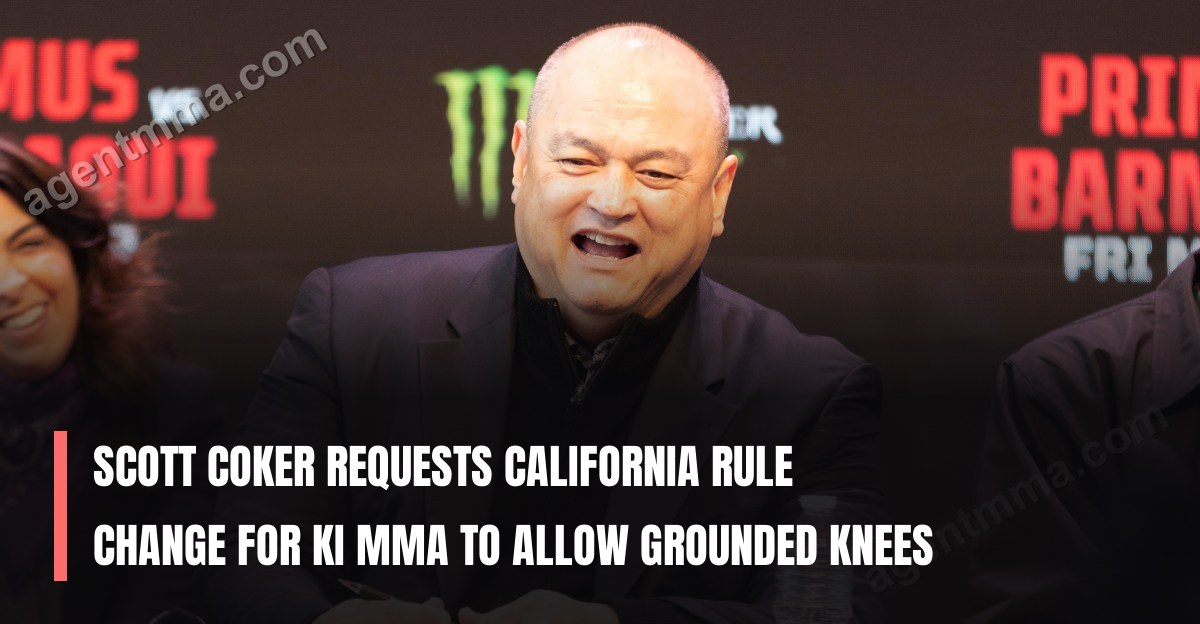
Scott Coker has formally requested that the California State Athletic Commission discuss rule changes for his new Ki MMA promotion, bringing elements of global MMA rules into the unified rules while excluding soccer kicks, stomps and linear knee strikes. The request is reportedly aimed at allowing knees to the head of a grounded opponent, which current unified rules prohibit. Coker has asked for the topic to be placed on the agenda for the commission's Dec. 1 stakeholders meeting. Ki MMA, launched in September with Rich Chou, is expected to open with a 32-fighter featherweight grand prix held in a ring.
Scott Coker has formally asked the California State Athletic Commission to discuss changes to the sport's rulebook for Ki MMA, his new promotion, as first reported by MMA Fighting.
Coker wants elements of the global MMA rules brought into the unified rules used in California. The request is reportedly aimed at allowing knees to the head of a grounded opponent, a strike the current unified rules prohibit. Soccer kicks, stomps and linear knee strikes would remain off the table under his proposal.
Coker has asked that the topic be placed on the agenda for the commission's Dec. 1 stakeholders meeting. A stakeholders meeting is a forum for discussion, so the request does not amount to an approved rule change.
About Ki MMA
Ki MMA launched in September, with Coker partnering with Rich Chou. The promotion is expected to open with a 32-fighter featherweight grand prix, and the bouts are expected to take place in a ring rather than a cage.
The ring format and the rule request point to a deliberate effort to set the promotion apart from the unified-rules, cage-based model that dominates the sport in North America.
Why it matters
- Grounded knees: Under the unified rules, a fighter who has a hand or knee on the mat is considered grounded and cannot be kneed to the head. Global rule sets used elsewhere permit the strike.
- Selective adoption: By carving out soccer kicks, stomps and linear knees, Coker is seeking a middle path rather than a full switch to the rules used in other parts of the world.
- Regulatory path: California is one of the most influential athletic commissions in the United States, and any change there would be closely watched by other regulators and promoters.
- Tournament planning: With a 32-fighter featherweight grand prix expected to open the promotion, the ruleset is a foundational question for how those fights would be fought.
The commission has not indicated how it will respond, and the Dec. 1 meeting is the first scheduled opportunity for the proposal to be aired.