
Creatine for MMA: Does It Help Fighters Perform Better?
Does creatine for MMA improve power or just add weight? Compare combat-sport trials, Makhachev and Talbott's accounts, and what the evidence cannot prove.


Quick answer
Creatine can help MMA fighters build strength and produce short bursts of power. That doesn't mean it improves every grappling test, prevents late-round fatigue, or raises your chance of winning. Combat-sport trials give mixed results, and added body mass can complicate a weight limit. The useful question is whether a measured training benefit fits your weight plan. Islam Makhachev and Payton Talbott have publicly discussed taking creatine; their experiences make the question relevant, but neither fighter's routine proves what the supplement does.
Data snapshot: A 2025 review covers 19 combat-sport studies searched through March 2025. The comparison below examines placebo-controlled wrestling trials published in 2003 and 2015, with 20 athletes each. These are exercise tests, not UFC fight-outcome data.
What does creatine actually do for an MMA fighter?
Creatine supports rapid energy supply during hard efforts: Sport Integrity Australia explains that it helps regenerate ATP, the fuel your muscles use. The proposed MMA benefit concerns repeated bursts: driving through a takedown, escaping a position, or throwing a combination.
That last step needs care because a useful energy pathway doesn't tell you how much better a fighter becomes. You still need tests that resemble the demand you're trying to improve.
Think about the difference between finishing a lift and finishing a takedown. The lift has a known load and movement, while the takedown adds timing, balance, resistance, and an opponent who changes the problem.
More physical capacity may help, but it doesn't supply the missing technique.
The Australian Institute of Sport identifies creatine monohydrate as the form with the strongest research base. Its guidance supports benefits in brief, intense exercise and resistance training. Those findings make creatine worth studying in MMA, but they don't establish a knockout bonus or a submission advantage.
What do controlled combat-sport studies actually show?
The result depends on the test. Koçak and Karli's wrestling trial and Aedma's later study show why a yes-or-no answer loses detail.
| Study | Athletes | Test | Main finding |
|---|---|---|---|
| Koçak and Karli, 2003 | 20 international-level wrestlers | 30-second Wingate cycling test | Creatine-group peak power rose from 8.992 to 10.523 W/kg; gains exceeded placebo, p<0.01 |
| Aedma and colleagues, 2015 | 20 male amateur BJJ/submission wrestlers | Repeated arm-cranking tests after 5 days | No detected improvement in peak power, mean power, or fatigue index |
W/kg means watts per kilogram of body mass, so it describes power relative to size. Neither row measures punching force, successful takedowns, or rounds won.
Don't read the table as a contest where each paper gets a vote, since the athletes and tasks differ. A cycling improvement and an unchanged arm-cranking result can both be accurate.
The wider picture remains positive but specific: Ashtary-Larky's review reports strength and power benefits, without improved sport-specific endurance, recovery, or fatigue measures.
That distinction matters if you're buying creatine for MMA cardio: a better short effort doesn't automatically mean less fading across a fight. Ask which outcome the paper measured before accepting the headline.
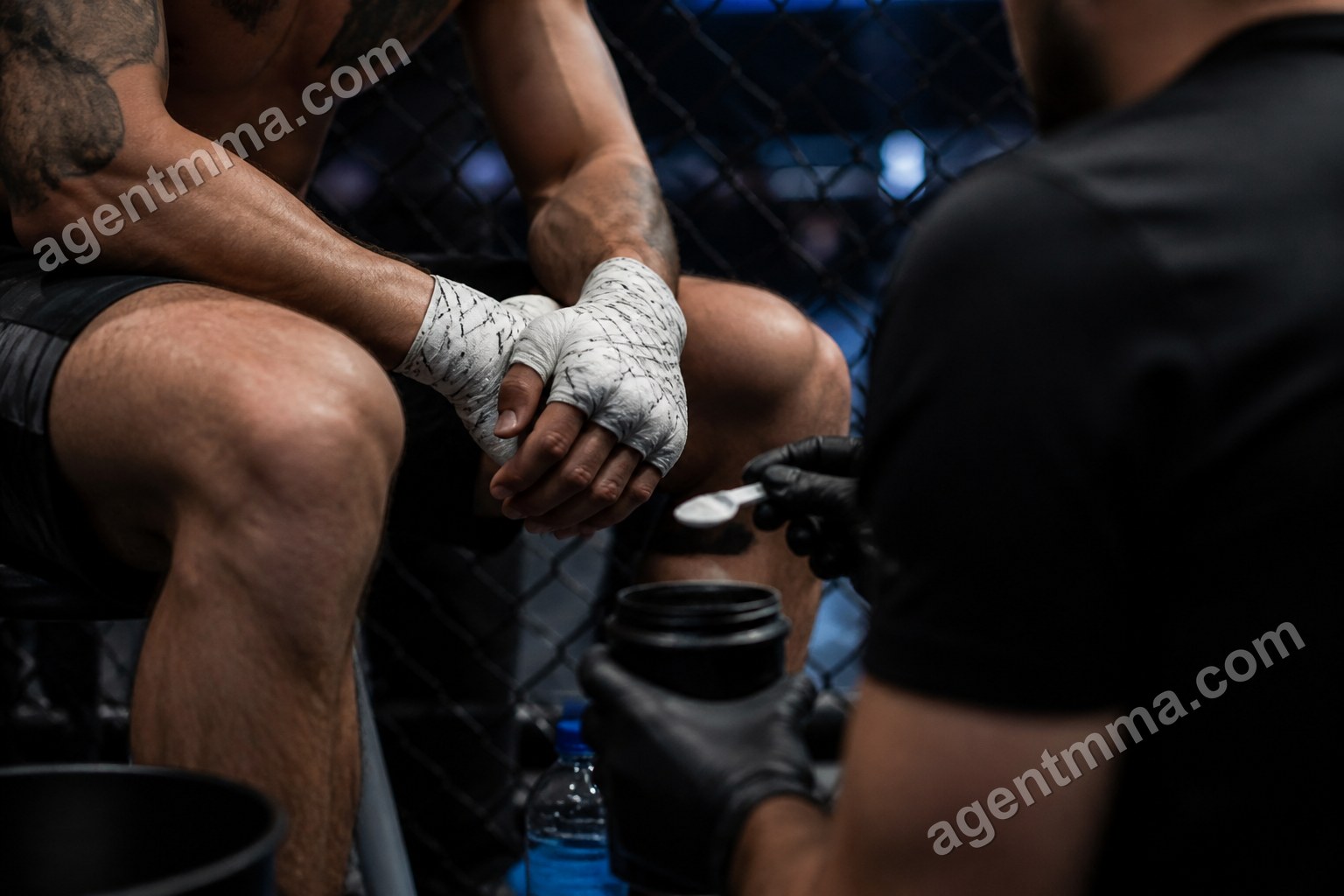
What can Makhachev and Talbott tell us?
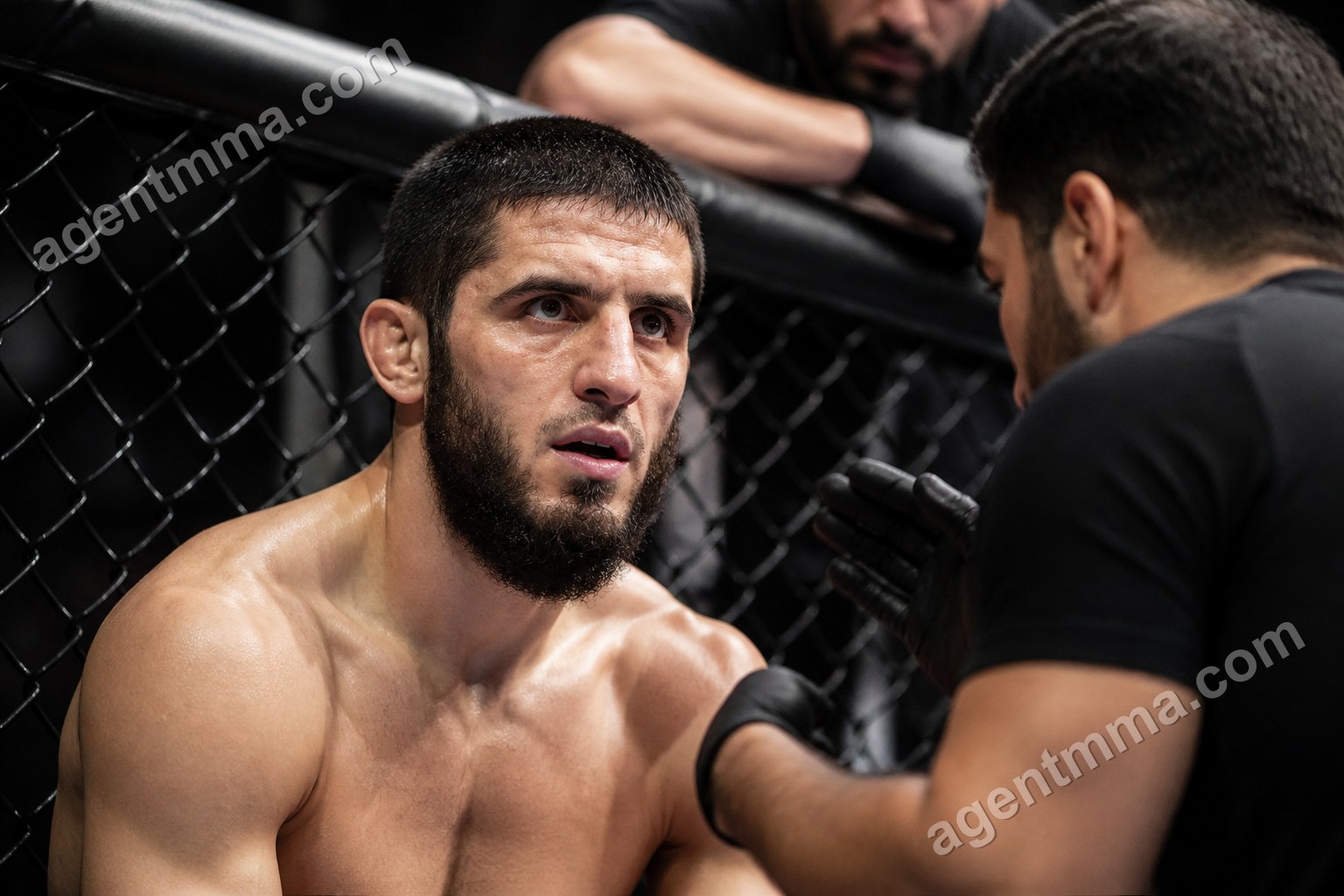
Makhachev told ESPN ahead of UFC 322 in 2025 that he had started using creatine. He also described eating more and using protein, making his account a useful example of overlapping changes.
You cannot isolate a supplement when the food plan and training context change alongside it. A photograph of a bigger athlete cannot separate those causes either, nor can a later win settle the question.
Payton Talbott told GQ in 2025 that he takes creatine, providing evidence of use with a clear source. It isn't a controlled comparison of his performances with and without it.
Both stories connect the research to recognizable athletes, but treat them as the start of an investigation, rather than its answer. Public disclosures also don't reveal a complete routine or prove that use continues unchanged today.
Does creatine make cutting weight harder?
Added scale weight creates a real planning issue, even when a training effect is useful. The AIS describes water-related weight gain and a gradual return toward baseline after stopping, over 4–6 weeks rather than overnight.
That isn't a universal countdown for making weight, but a reason to question last-minute advice based on a teammate's experience.
Consider two hypothetical athletes: one wants to develop strength while moving into a heavier division. The other already struggles to reach the same weight limit, so an identical scale change would mean different things to them.
Calling all extra weight good or bad misses that difference: compare the training benefit with the demands of the chosen division.
Ricci, Forbes and Candow's MMA review recommends tracking body mass when introducing creatine. The practical lesson is to measure your own response before a weigh-in deadline limits your options.
This doesn't justify compensating with more dehydration, since a supplement decision and a weight-cut plan need to work together. If they conflict, discuss the plan with a qualified sports dietitian rather than improvising during fight week.
Can creatine improve punching power or prevent gassing out?
The studies above cannot answer either question directly: cycling watts aren't the force delivered by a punch. An arm-crank fatigue index isn't a record of how well someone defends under pressure.
You should also separate capacity from how a fighter spends it. Imagine an athlete who gains power but attacks more often: the extra output could hide any improvement in fatigue during a casual viewing.
The opposite error is possible too: a fighter working at a slower pace may look fresher without gaining any physical capacity. These are interpretation problems, not proof that creatine causes either pattern.
A useful punching-power study would keep the testing setup consistent and compare creatine against placebo. A useful endurance study would define the task, work rate, and recovery periods. Saying someone looked explosive leaves all those questions open.
For fight predictions, don't turn a supplement interview into a numerical advantage. The cited research provides no validated adjustment to a UFC win probability, so treat that missing link as missing.
How should you judge a creatine claim before using it?
Start with your chosen outcome, then inspect the evidence behind it to stop a product claim from changing the question halfway through.
- For strength, look for a defined strength test and a comparison group.
- For repeated efforts, check whether the study measures repeated work rather than a single peak.
- For weight management, track scale changes alongside the training result.
- For MMA performance, ask whether researchers tested fighters, related-sport athletes, or a different population.
If you train, use a consistent training log to make discussions with your coach more useful. Record the exercise, load, repetitions, recovery periods, and body mass, noting changes to sleep, food, and training volume too.
A log isn't a clinical trial, so it won't remove expectation effects or prove causation. It can stop you calling every good session a supplement success and every bad session an exception.
Judge the decision against a goal you chose beforehand. Otherwise, it's easy to celebrate extra mass after promising yourself better endurance, even though those are different outcomes.
Is creatine legal, and does product quality matter?
Sport Integrity Australia says creatine isn't prohibited under the World Anti-Doping Code. It also warns that supplements can contain banned contaminants and recommends batch-tested products.
Ingredient status and product contents are separate checks, since a label saying creatine doesn't establish what else is in the container. A famous athlete's endorsement doesn't resolve that problem.
Ask your sport's medical or nutrition team about the exact product, keeping health questions separate from performance claims too. Evidence that an exercise result improves cannot establish suitability for every person or medical condition.
How solid is this data?
This is a review of published evidence, not an AgentMMA database outcome study. The table contains small experiments with different tasks and doesn't establish how elite UFC fighters respond during a weight cut.
Aedma's participants weren't cutting weight. The researchers used blinding and placebo, but assigned groups alternately after sorting body mass, which isn't random allocation.
Those details limit your inferences, alongside the gap between exercise tests and combat, and the lack of an opponent in laboratory tasks.
The two trial samples should not become a pooled MMA success rate because they don't share a fight outcome to pool. The broader review also doesn't turn its collection of studies into a count of UFC athletes.
FAQ
Is creatine good for MMA?
It can support some physical goals, especially strength and short bursts of power. Whether it fits your preparation depends on the goal and weight constraints. The evidence here doesn't establish better UFC results.
Does creatine improve MMA cardio?
Improved short-effort power doesn't prove better fight endurance. Check whether a study measures repeated performance, fatigue, or a single effort, and don't use those outcomes interchangeably.
Should MMA fighters stop creatine before weighing in?
These studies establish no universal schedule, so base the decision on your measured response and an agreed weight plan. Changing supplements during fight week isn't a substitute for that plan.
Does taking creatine mean a fighter will hit harder?
No such conclusion follows from the wrestling trials here because they measure exercise performance, not punch impact. A claim about punching needs evidence from a punching test.
Sources & further reading
The data and published sources behind this article.
- Ashtary-Larky et al.: Creatine Supplementation in Combat Sport Athletes (2025) (pubmed.ncbi.nlm.nih.gov)
- Koçak and Karli: Effects of high dose oral creatine supplementation on anaerobic capacity of elite wrestlers (2003) (pubmed.ncbi.nlm.nih.gov)
- Aedma et al.: Short-term creatine supplementation has no impact on upper-body anaerobic power in trained wrestlers (2015) (pmc.ncbi.nlm.nih.gov)
- Australian Institute of Sport: Creatine (www.ausport.gov.au)
- Ricci, Forbes and Candow: Creatine Supplementation: Practical Strategies and Considerations for Mixed Martial Arts (2020) (www.journalofexerciseandnutrition.com)
- ESPN MMA: Islam Makhachev discusses creatine before UFC 322 (2025) (www.youtube.com)
- GQ: The Real-Life Diet of UFC Fighter Payton Talbott (2025) (www.gq.com)
- Sport Integrity Australia: Creatine use in sport (www.sportintegrity.gov.au)
Put the data to work
Compare any two fighters head-to-head, or see what our AI predicts for upcoming UFC fights.
More from the MMA Lab

Vegan Diet for MMA: Does It Hurt Strength and Cardio?
Does a vegan diet for MMA hurt strength or cardio? Compare athlete trials, Nate Diaz's diet claims, protein needs and the limits of fight-performance evidence.

Does Caffeine Improve MMA Performance? What Data Shows
Caffeine and MMA performance don't always move together. Compare a direct punching trial, combat-sport reviews, fighter habits and the cost to sleep.