
What Counts as a Knockdown in UFC Stats? A Clear Guide
What counts as a UFC knockdown? Learn how UFC Stats records knockdowns, why disputed falls differ, and how KDs affect judging without guaranteeing 10-8.


Quick answer
A UFC knockdown is recorded when a legal strike makes a fighter fall because they were hurt, rather than because they slipped or lost balance. The fighter doesn't need to lose consciousness, and there is no boxing-style count. If the action continues, the moment can still appear as a knockdown in UFC Stats, but that number does not decide the round. Judges assess the damage they saw, and one knockdown does not create an automatic 10-8 score.
Data snapshot: UFC's Record Book covers UFC 28 onward and was last updated August 1, 2026. Its rate list requires five UFC fights, while the judging evidence covers 5,976 judge-rounds from January 30, 2016 through April 20, 2019.
What counts as a knockdown in UFC stats?
The cleanest public definition has two parts: a strike causes the fall, and damage causes the loss of footing. Sportsnet's FightMetric-era glossary says a knockdown occurs when a strike drops a fighter through debilitation. A trip, foot sweep, or simple loss of balance does not count.
The Association of Boxing Commissions scoring guide uses similar language, defining a knockdown as a legal, detrimental strike that forces an opponent to the canvas. That definition appears under damage, which the guide ranks above dominance and duration.
Put those sources together and you get a useful three-part test:
- A legal strike lands.
- The strike hurts or impairs the opponent.
- That effect causes the opponent to fall to the canvas.
This is why a glove or knee touching the floor isn't enough by itself; the cause matters. A fighter can duck too low, stumble over crossed feet, or get pulled down during a clinch. Those moments may look dramatic without meeting the UFC knockdown definition.
The reverse also matters because fast recovery doesn't erase the strike's effect. A flash knockdown can count even when the hurt fighter springs up at once.
Why do borderline UFC knockdowns cause arguments?
Real exchanges don't arrive in neat categories, and a punch may land as a fighter changes level. A kick may buckle a leg just as the fighter pivots. One camera angle can show the impact while another makes the fall look like a slip.
Someone still has to classify the sequence. FightMetric supplied live round-by-round data to UFC broadcasts and built the system behind UFC's historical stats. Its founder, Rami Genauer, explained that live figures were quick counts the team could revise after slow-motion review.
That human review is sensible, but it leaves judgment at the boundary. Public UFC Stats pages show the final KD total without a frame-by-frame ruling for every rejected claim.
Use this checklist when a disputed UFC knockdown appears:
| What happened? | Likely statistical treatment | Why |
|---|---|---|
| A clean punch drops a standing fighter to knees or hips | Knockdown | Legal strike caused a damaging fall |
| A fighter slips while evading a missed strike | No knockdown | No landed strike caused the fall |
| A foot sweep removes the base without strike damage | No knockdown | The fall came from a sweep, not debilitation |
| A hurt fighter posts one hand and rises immediately | Borderline | The scorer must separate damage from balance |
| A fighter is already grounded and absorbs more strikes | No new knockdown | The strikes did not force a standing fighter to the canvas |
The table is a reading guide, not UFC's private coding manual. The first three rows follow the public definitions closely, while the last two need video context.
Is a knockdown the same as a knockout or takedown?
No. These labels describe different events.
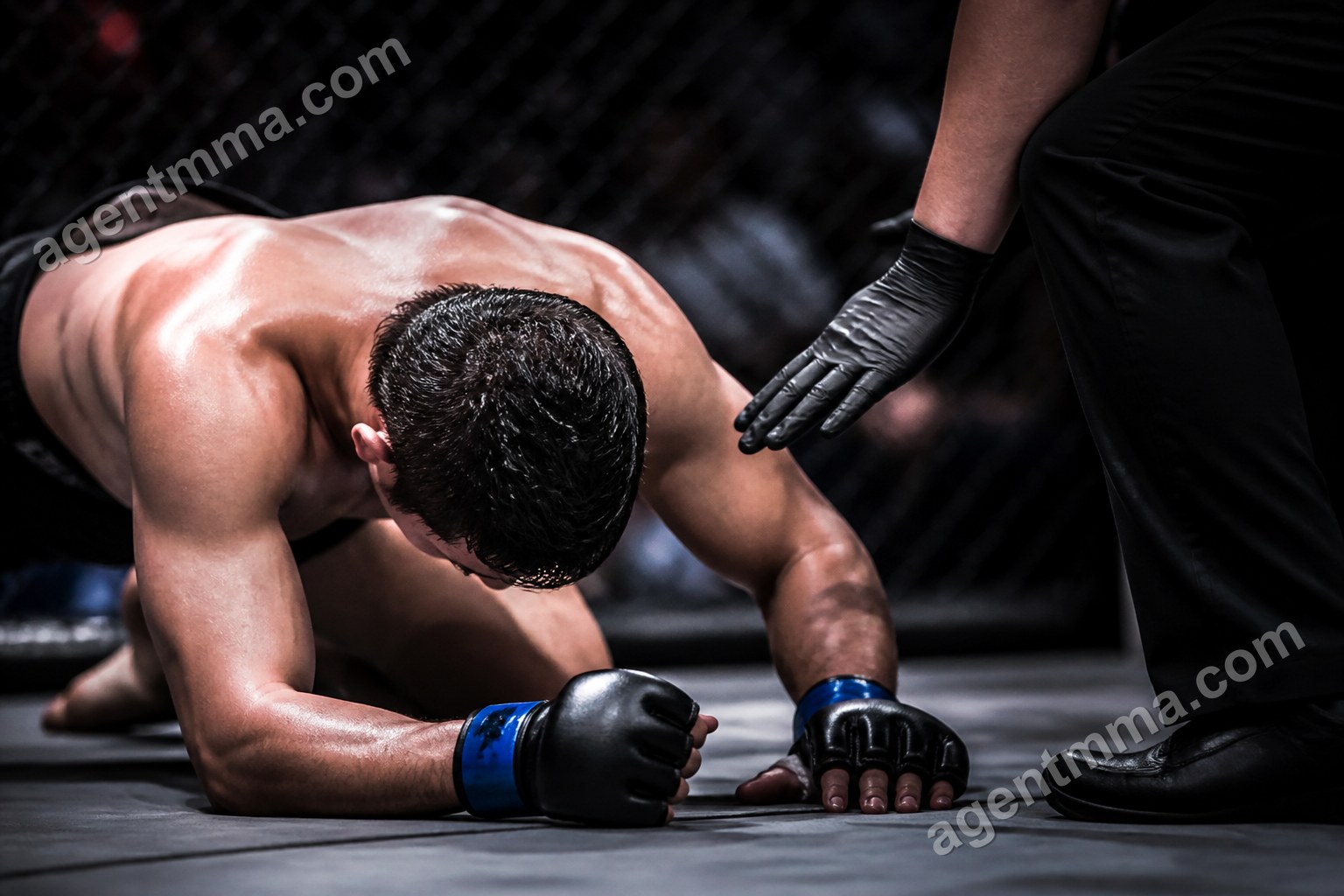
A knockdown is a statistic inside the fight, and the bout continues because the referee believes the dropped fighter can still defend. MMA has no recovery count after the fall, so the opponent may follow with legal ground strikes.
A knockout or technical knockout is a fight result. Under the Unified Rules, the referee stops the contest when the fighter cannot intelligently defend. One punch can produce both a knockdown and the finishing sequence, though many knockdowns produce neither result.
A takedown begins with grappling as the attacker deliberately brings the opponent down and establishes an advantageous position. A trip from the clinch may be a takedown even though it looks like a knockdown from a wide camera view.
Ilia Topuria's win over Max Holloway at UFC 308 shows the categories working together. UFC Stats credits Topuria with one knockdown and lists a third-round KO/TKO at 1:34. The KD records the damaging fall, while the result records the referee's decision to end the bout.
Does a UFC knockdown automatically win the round?
No fixed-points rule exists because the judge scores the whole round under MMA's ordered criteria. A UFC judge does not subtract one point for each knockdown as a boxing scorecard effectively does.
The ABC guide places damage first and gives immediate damage priority over cumulative damage within the round. A genuine knockdown is direct evidence that a strike reduced the opponent's ability to compete, so it usually carries serious weight.
Usually is not always.
Imagine Fighter A scores a brief flash knockdown, then loses the next four minutes to harder strikes and dangerous submission attempts. The early KD stays in the statistics, yet Fighter B may deserve the round because their total effective offense caused more damage.
The opposite error is counting volume without effect because judges compare what the attacks did, not only how many landed. Twenty light touches do not automatically outweigh the strike that badly drops an opponent.
FightMetric's founder made the same separation from another angle. He warned against using live data to declare a winner because the counts could change and judging criteria are qualitative. UFC Stats helps you reconstruct a round, but it is not the scorecard.
Does one knockdown make a round 10-8?
No. The 2025 ABC clarification says a 10-8 round must include significant damage. Significant damage can be enough on its own, but the document never makes one knockdown an automatic trigger.
Severity changes the answer because a knockdown that leaves a fighter badly hurt for the rest of the round can support a 10-8. A quick stumble after a clean shot may fit a 10-9, especially if the remaining action is competitive.
The best published numbers support that distinction. Economist Paul Gift studied 5,976 UFC judge-rounds from 2016 through April 2019 where all three judges agreed on the round winner. His model controlled for 29 performance measures, and knockdowns produced the largest effect among the measured fight actions. An extra knockdown was associated with a 5.6 percentage-point rise in the chance of a 10-8.
That is a strong signal, not an automatic score, and most rounds in the sample still did not receive a 10-8. The model also found links for visible damage, dominant positions, submission attempts, and power strikes.
Israel Adesanya's fight with Kelvin Gastelum at UFC 236 is the useful extreme, with UFC Stats recording four Adesanya knockdowns in the bout. Its round breakdown shows three came in round five, making that late surge an extreme case of immediate damage. It also shows why KD totals need context: three knockdowns in one round differ from isolated flash falls.
What do the UFC knockdown leaders actually tell you?
Career totals reward power, durability, and time in the promotion, and the two UFC Record Book lists answer different questions. Knockdowns per 15 minutes reward pace, but can lift fighters with short bouts.
| Career knockdown leaders | Total | Knockdowns per 15 minutes, minimum five fights | Rate |
|---|---|---|---|
| Donald Cerrone | 20 | Drew McFedries | 4.27 |
| Anderson Silva | 18 | Chris Daukaus | 3.54 |
| Jeremy Stephens | 18 | Tom Aspinall | 3.27 |
| Edson Barboza | 16 | Ateba Gautier | 3.27 |
| Dustin Poirier | 15 | Uroš Medić | 3.20 |
Anderson Silva's 18 tell you he produced knockdowns across a long UFC career. Drew McFedries' 4.27 tells you his knockdowns came at a high rate over his recorded fight time. It doesn't make either man the automatic answer to “who hit harder?”
Division, opposition, and fight length shape both lists, while heavy hitters often end bouts before they can add a second knockdown. A fighter who hurts opponents but follows with submissions can also have fewer KDs than their finishing ability suggests.
For prediction work, use knockdowns as one part of a striking profile. Check knockdown rate alongside accuracy, attempts, opponent quality, and strikes absorbed, then watch the actual sequences. A model that treats every KD as identical throws away the feature's most useful detail: how the damage happened.
How solid is this data?
The definitions are stronger than the counts at the margins, and Sportsnet's glossary states the old FightMetric standard clearly. The ABC guide gives the current judging meaning, but neither source publishes the UFC stat crew's full modern coding manual.
UFC's Record Book starts at UFC 28, so it does not cover the promotion's earliest events. Its rate leaderboard excludes fighters with fewer than five UFC bouts, which removes some tiny samples but does not make every remaining rate stable.
Gift's judging study includes 5,976 judge-rounds but ends in 2019, covering only rounds with a unanimous winner and available scorecards. The estimated 5.6-point change is an association inside a model, not proof that adding one KD causes the same scoring shift in every round.
Camera angles, live-count errors, and later review can change a borderline label, while era, weight class, opponent strength, and UFC tenure distort leaderboards. Treat KD as useful evidence, not ground truth about damage or punching power.
FAQ
What counts as a knockdown in UFC?
A UFC knockdown occurs when a legal strike hurts a fighter and causes them to fall to the canvas. A slip, trip, foot sweep, or balance loss without strike-driven debilitation does not count.
Does a knockdown automatically win a UFC round?
No. Judges value the damage behind a knockdown, but they score all effective striking and grappling across the round. A fighter can score a flash knockdown and still lose the round.
Is every UFC knockdown a 10-8 round?
No, because a 10-8 requires significant damage under current ABC guidance. One severe knockdown may support that score, while a brief knockdown in a competitive round may still produce a 10-9.
What is the difference between a knockdown and a takedown?
A strike causes a knockdown by hurting the opponent and sending them down. Grappling causes a takedown when a fighter deliberately brings the opponent down and establishes an advantageous position.
Who has the most knockdowns in UFC history?
The UFC Record Book lists Donald Cerrone first with 20 career knockdowns from UFC 28 onward. Anderson Silva and Jeremy Stephens share second place with 18 each.
Sources & further reading
Peer-reviewed studies and primary data behind this analysis.
- ABC: MMA scoring clarification (www.abcboxing.com)
- ABC: Unified Rules of MMA (www.abcboxing.com)
- UFC Record Book (statleaders.ufc.com)
- Sportsnet: MMA statistics glossary (www.sportsnet.ca)
- MMA Fighting: FightMetric data collection (www.mmafighting.com)
- Gift: MMA 10-8 scoring study (journals.sagepub.com)
- UFC Stats: Topuria vs. Holloway (ufcstats.com)
- UFC Stats: Adesanya vs. Gastelum (ufcstats.com)
Put the data to work
Compare any two fighters head-to-head, or see what our AI predicts for upcoming UFC fights.
More from the MMA Lab
Are UFC Submissions Becoming Less Common? What Data Says
Is the UFC submission rate falling? Data from 3,123 pay-per-view fights and 906 finishes shows fewer submissions overall but a sharper choke mix.

Are UFC Fighters Striking More? What 8,751 Fights Show
UFC significant strikes per minute rose from 2.81 to 8.05 across eras. See what 8,751 fights show, why raw totals mislead, and grappling's role.

How Often Do UFC Fights Go to Decision? What Data Shows
How often do UFC fights go to decision? An 8,591-bout study shows the overall rate, division gaps, decision types, yearly swings, and limits.

How Does UFC Pick Fight of the Night? What Data Shows
How does UFC pick Fight of the Night? A 15-year study shows how action, card position, recency and live crowds can shape the final award choice.