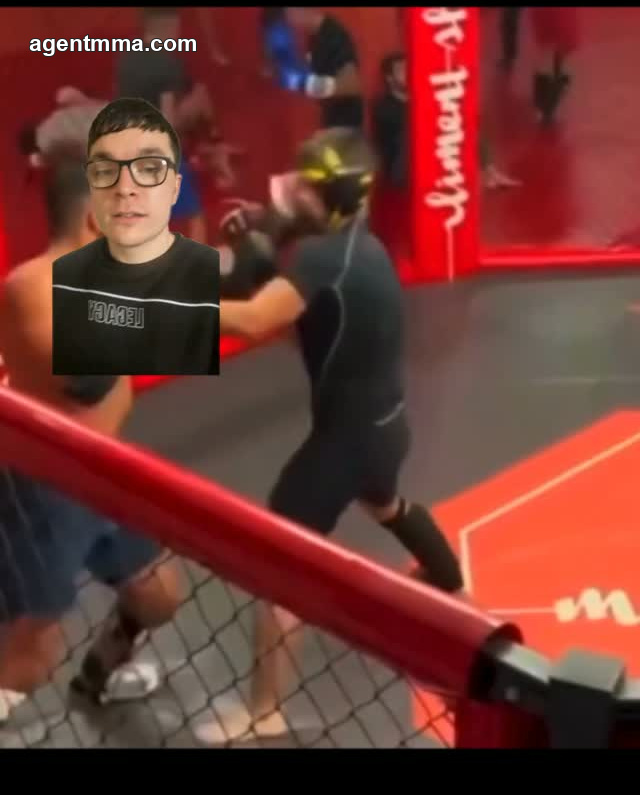

An MMA analyst expressed surprise that strikers in 2026 still do not utilize even the threat of wrestling to their advantage. The post referenced the Khabib vs Iaquinta fight, noting that even Iaquinta successfully used wrestling feints twice against Khabib—once forcing a clinch engagement that allowed him to land a left hook on the break, and another time using a fake level change that made Khabib duck and opened him up for an uppercut. The analysis emphasized that while observers know a striker may not actually complete a takedown, the opponent's body reacts automatically to wrestling feints in real-time, creating 0.2-0.5 second windows for strikes. The post specifically criticized Prochazka's approach against Ulberg at UFC 327, noting that Prochazka had only 5 takedown attempts in his entire UFC career and failed to mix in wrestling threats or clinch work despite Ulberg's vulnerability and even after Ulberg injured his knee. The analyst compared this to Petr Yan, who had 65 takedown attempts in the UFC despite being primarily a striker.
A recent analytical piece has reignited debate over a persistent tactical blind spot in mixed martial arts: the failure of striking-focused fighters to weaponize even the threat of a takedown, let alone the attempt itself.

The analysis drew on a well-known example to make the point, revisiting Khabib Nurmagomedov's lightweight title fight against Al Iaquinta. Nurmagomedov, the undefeated Russian grappler who averaged an extraordinary 5.32 takedowns per 15 minutes across his UFC career, was still vulnerable to wrestling feints from Iaquinta — a striker who averaged just 0.63 takedowns per 15 minutes and shot only rarely. According to the analysis, Iaquinta used a feint to force a clinch exchange and land a left hook on the break, and a fake level change that caused Nurmagomedov's body to react instinctively, opening him up for an uppercut. The analyst's core argument: the nervous system responds automatically to wrestling threats in real time, creating windows of 0.2 to 0.5 seconds that skilled strikers can exploit.

The piece then turned to Jiri Prochazka's performance at UFC 327 on April 11 as a contemporary example of the same missed opportunity. Prochazka, the 33-year-old Czech light heavyweight ranked second in his division, carries a record of 32-6-1 and generates 5.69 significant strikes per minute at 55 percent accuracy — elite output by any measure. Yet the analyst pointed out that Prochazka has logged only five takedown attempts across his entire UFC career, and against his opponent Carl Ulberg, he declined to incorporate wrestling feints or clinch work even when Ulberg suffered a knee injury during the bout.

Why it matters
- Prochazka's near-total absence of wrestling threats — five career UFC attempts — leaves a significant tactical dimension unused
- Petr Yan, cited as a counter-example, accumulated 65 takedown attempts in the UFC despite being primarily a striker, demonstrating that striking-focused fighters can integrate the wrestling threat effectively
- The argument applies broadly: if even Iaquinta could disrupt Nurmagomedov with feints, strikers at every level have more tools available than they are currently using


Saturday, April 11, 2026