

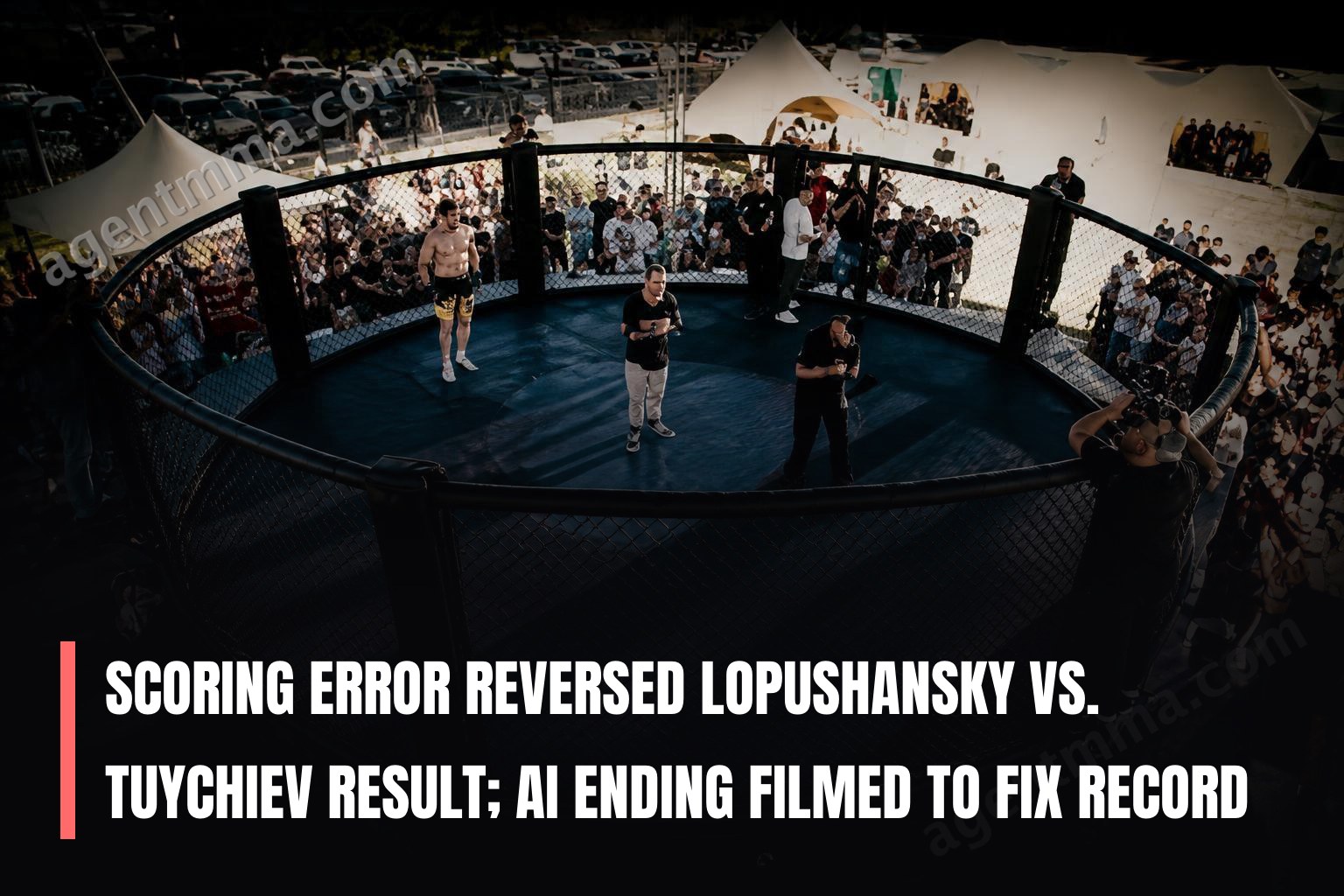
Judges in the Lopushansky–Tuychiev bout initially scored the fight 2–1 in favor of Tuychiev and raised his hand, but had failed to account for a one-point deduction Tuychiev had received for missing weight. After the announcement, the judges approached the organizers and acknowledged the mistake, prompting a reversal of the official result. To ensure the corrected outcome was captured for the statistical record, organizers arranged for an AI-generated alternative ending to be produced.
A scoring error overturned the result of the Lopushansky–Tuychiev bout, with the correct winner's hand raised only after organizers intervened following a mistaken announcement.
Judges initially scored the fight 2–1 in favor of Tuychiev and declared him the winner, but they had failed to factor in a one-point deduction Tuychiev had already received for missing weight. That deduction, applied before the bout began, was enough to shift the final tally. The judges themselves recognized the oversight and approached organizers after the announcement to acknowledge the error, prompting an official reversal of the result.
The situation created an unusual administrative challenge: because the incorrect result had already been declared publicly, the corrected outcome needed to be documented for the statistical record in a way that was clear and verifiable. To address that, organizers arranged for an AI-generated alternative ending to be produced, capturing the proper result so it could be formally logged.
Why it matters
- Weight-miss deductions directly affect scorecards and must be tracked through the entire judging process, not applied only at the weigh-in stage.
- The reversal highlights the risk of announcing results before all scoring variables — including pre-fight deductions — have been confirmed by officials.
- The use of an AI-generated sequence to document the corrected outcome raises broader questions about how governing bodies and statistical platforms handle administrative fixes to official records.
- Both fighters' career records are affected by which way the result stands, making the integrity of the correction process consequential beyond this single event.