
Why Do UFC Fighters Look So Drained at Weigh-Ins?
Fighters regain 7.5 kg in 30 hours after a weigh-in. What research says a drained, hollow face can and cannot tell you about a weight cut.

Quick answer
Because they have just spent a week removing roughly a tenth of their body mass, and most of what left was water. A supervised seven-day protocol moved 31 professional MMA athletes 7.25 kg — 10.56% of body mass — before the scale, with fluid intake tapered from about 7 L a day down to 0.5 L on the final day. Facial skin also loses water faster than skin elsewhere on the body, and fight week stacks a second cause on top: 31 hours without sleep is enough on its own to produce the drooping eyelids, swollen eyes and dark circles that observers rate as fatigue.
What that face cannot tell you is how bad the cut actually was. In the largest test of the idea — 606 marathon finishers weighed immediately before and after the race — visibly decreased skin turgor separated a 3.0% body-mass loss from a 2.3% one, and the authors concluded that no clinical sign reached acceptable validity for detecting a loss of 3% or more. A weigh-in face is two things stacked, a full camp's energy deficit that will not reverse by Saturday and a day or two of fluid loss that mostly will, and neither an eye nor an algorithm has been shown to separate them.
Data snapshot: 40 professional MMA fighters measured about 24 h and about 2 h before competition. 31 professional MMA athletes on a supervised seven-day protocol. 606 finishers of the 2006 Auckland Marathon. A systematic review of 13 skin-turgor studies. 11 haemodialysis patients. 49 women in a four-week water-intake trial. 9 aerobically trained subjects biopsied after heat dehydration. 40 observers rating 20 photographs taken across 31 hours of sleep deprivation.
How much weight do UFC fighters actually lose before a weigh-in?
Start with the number, because the number is the reason the face looks like that.
Maurício and colleagues put 31 professional MMA athletes — 28 men and 3 women, mean age 28 ± 4 — through a structured seven-day weight-management protocol supervised by a certified sports nutritionist, with daily meal photographs and real-time corrective feedback. They reached the scale 7.25 kg lighter, 10.56% of their starting body mass, in seven days.
Two cautions belong immediately next to that figure.
It is not a measurement of how far below "walk-around weight" a fighter competes. That is a larger and separately defined quantity, and nobody in this literature measured it. And this was a designed protocol, published explicitly as a safer alternative to typical rapid weight loss. It describes what a modern, supervised cut looks like — not the worst thing anyone does in an unsupervised sauna.
The fluid schedule inside that protocol is what puts the hollows in the face. Water intake began at roughly 7 L a day a week out and tapered to 0.5 L on the day before the weigh-in.
How often this process fails outright is a different question, with its own data: see did UFC early weigh-ins reduce weight misses.
How much weight do fighters put back on between the weigh-in and the fight?
Most of it, and fast.
In that same supervised cohort, athletes regained 7.5 kg inside a 30-hour recovery window — 11.25% of their weigh-in weight. The protocol fed them a 1.5 L electrolyte drink over the 90 minutes after weighing in, and about 7 L in total across the recovery period.
Jetton and colleagues measured the same rebound in the wild rather than under a protocol: 40 professional MMA fighters, assessed about 24 hours before competition and again about 2 hours before it. Mean acute weight gain over roughly 22 hours was 3.40 ± 2.2 kg, or 4.4% of body weight. One fighter in that sample came back roughly 10% heavier.
That rebound is what a crowd reads as "he recovered well." Whether it helps him win is a separate question with its own evidence: see does fight-night weight regain help UFC fighters win.
Does the rebound mean a fighter is actually rehydrated?
Not reliably — and this is the single most useful finding in the MMA-specific data.
Urine specific gravity in Jetton's fighters fell from 1.028 ± 0.001 at the weigh-in to 1.020 ± 0.001 two hours before competition (p < 0.001). That is real rehydration. And yet 39% of them were still significantly dehydrated (Usg > 1.021) two hours before the first bell; of those fighters, 11% were seriously dehydrated (Usg > 1.030). Read the nesting carefully — the 11% is a share of the 39%, not of the whole sample.
Then comes the line that should end most weigh-in-face arguments. The authors found no significant correlations between changes in body weight and changes in urine specific gravity.
Even the scale — an instrument vastly better than a human eye — did not track hydration status. A face is not going to do what the scale could not.
What does dehydration actually do to skin?
Three separate mechanisms, on three different clocks.
Fluid volume. Palma and colleagues added a mean surplus of about 2,000 mL of water a day to the normal diets of 49 healthy women (24.5 ± 4.3 years) over four weeks. In the lower-baseline-intake group (n = 38, under 3,200 mL/day), forehead superficial hydration rose from 53.97 ± 22.44 to 75.52 ± 14.31 AU (p < 0.001). Measures related to skin elasticity improved significantly at the leg (p = 0.007) and the forehead (p = 0.031). Dietary water genuinely moves measurable skin properties — over weeks, not over a Friday afternoon.
Muscle water, which is most of the mass. Fernández-Elías and colleagues dehydrated 9 aerobically trained subjects by 4.6 ± 0.2% through 150 minutes of cycling at 65% VO₂max in 33 ± 4 °C heat, with muscle biopsies before exercise and at 1 h and 4 h after. Muscle water fell 13 ± 6% and glycogen 44 ± 10% (p < 0.05). Their conclusion: each gram of glycogen is stored in human muscle with at least 3 g of water. When fluid intake was restricted, water was stored with glycogen at a ratio near 1:3; when fluid replacement matched losses, the ratio was about 1:17.
That is why the deflated look is not skin-deep. Much of what disappears from a fighter's frame is water bound to depleted glycogen inside muscle.
The face is not the arm. The SkInDialysis study measured transepidermal water loss at three sites in 11 maintenance haemodialysis patients (27% female, age 55.4 ± 13.3) during forced fluid removal. At baseline, facial water loss was already higher than forearm (13.9 ± 5.5 vs 8.5 ± 3.0 mL/h/m², p = 0.001) and trunk (8.9 ± 3.1, p = 0.001). During treatment, forearm loss fell within 20 minutes (p = 0.002, consistent with vasoconstriction) and then returned to baseline; facial loss rose early (p = 0.01) and stayed elevated; the trunk did not change at all (p = 0.75).
Facial skin is regulated differently from the rest of the body, which is one reason the face is where fluid loss shows first. Two caveats: n = 11, and dialysis over roughly 160 climate-controlled minutes is a mechanistically different process from a sauna cut.
Can you tell how bad a weight cut was by looking at a fighter's face?
This has been tested directly, once, at scale — and it failed.
McGarvey and colleagues assessed five clinical dehydration signs in 606 finishers of the 2006 Auckland Marathon, weighed immediately before and after the race.
| Clinical sign | Mean weight loss when present | When absent |
|---|---|---|
| Decreased skin turgor | 3.0% (SD 1.4) | 2.3% (1.5) |
| Sunken eyes | 2.6% (1.5) | 2.3% (1.5) |
| Thirst | 2.5% (1.5) | 2.3% (1.5) |
| Dry oral mucous membranes | unrelated to weight loss | — |
| Inability to spit | unrelated to weight loss | — |
Their verdict, verbatim: "No signs/symptoms showed acceptably high validity for detecting a weight loss equal to or greater than 3% of body weight."
The honest limitation runs in the article's own direction and should be said out loud: these were runners losing 2–3% of body mass, not fighters who have deliberately shed something closer to a tenth of their body mass by sauna and fluid restriction. Nobody has tested whether the visible signs become discriminating at fight-week magnitudes. It is entirely possible that they do. It has simply never been measured in this population.
The measurement problem sits underneath the accuracy problem. A 2022 systematic review across six databases found 13 studies of skin turgor in humans — 8 of them at evidence level 4 — and reported that there is no gold-standard method for measuring skin turgor in clinical practice at all. Its conclusion: skin turgor "may not be the best assessment tool for some conditions or purposes in adults, such as dehydration."
Why are the eyes the first thing you notice?
Because eyes are where fatigue shows, and fight week is a fatigue event independent of any fluid loss.
Sundelin and colleagues photographed 10 people twice — at 14:30 after normal sleep, and again after 31 hours awake following a night of 5 hours' sleep — then had 40 observers rate the 20 photographs.
| Facial cue | Effect of sleep deprivation (b, mm on a 100 mm scale) |
|---|---|
| Hanging eyelids | 14.8 |
| Swollen eyes | 10.9 |
| Droopy mouth corners | 10.7 |
| Wrinkles / lines around the eyes | 7.4 |
| Dark circles under the eyes | 7.2 |
| Pale skin | 2.9 |
Hanging eyelids was both the largest effect and the strongest predictor of perceived fatigue (b = 0.4). Pale skin was the weakest on both counts (b = 0.1), though still statistically significant (p = 0.009) — worth noting, because "he looked pale" is a staple of weigh-in commentary. Glazed eyes were not affected by sleep deprivation at all (b = −1.7, p = 0.147) and yet still tracked observers' fatigue ratings.
So the drooping, swollen-eyed face at a Friday weigh-in is a genuine signal. It is a signal about sleep and energy availability across a hard week, and it looks identical to whatever the fluid loss is doing.
Why does the same fighter look normal again 24 hours later?
Because the fastest-moving component is the one that comes back fastest.
Fluid volume and glycogen-bound muscle water rebound within hours of eating and drinking — that is the 7.5 kg in 30 hours, and the 3.40 kg in 22 hours. Skin properties that respond to hydration status move on a much slower clock: Palma's measurable changes took four weeks of extra daily water.
Which means the fight-night face is mostly restored volume, not restored tissue. The energy deficit of a full camp underneath it has not gone anywhere overnight.
Does looking good on fight night mean the cut went well?
No, and Jetton's cohort is the direct counterexample: 39% were still significantly dehydrated two hours before competing, with no correlation between the weight they had regained and their hydration status.
There is also a well-evidenced reason that faces feel readable, and it points somewhere else entirely. Coetzee and colleagues recorded BMI and measured three facial ratios — width-to-height, perimeter-to-area, and cheek-to-jaw-width — across two Caucasian and two African participant groups. All three tracked BMI in men, and two of the three in women; observers then used all three cues to judge weight in faces of both sexes and both groups.
Observers really are reading something valid off a face. That something is adiposity. A face is a reasonably good fat gauge and a bad water gauge, and a weigh-in asks it to be the second thing.
How much can a single photo of a face actually measure?
If a trained clinician with a validated pinch test cannot read hydration off skin, the obvious follow-up is whether a camera and an algorithm can.
The genuinely interesting part of the answer is that computer vision can separate layers a human eye conflates. To make that concrete it helps to look at a worked example. GlowUp Face, a consumer AI face-analysis tool, publishes a full sample report from a single photograph. (Disclosure: GlowUp Face and AgentMMA share an owner. It is cited here because its output is published in full, which is what makes it checkable; nothing in the argument depends on which tool produced the maps.)
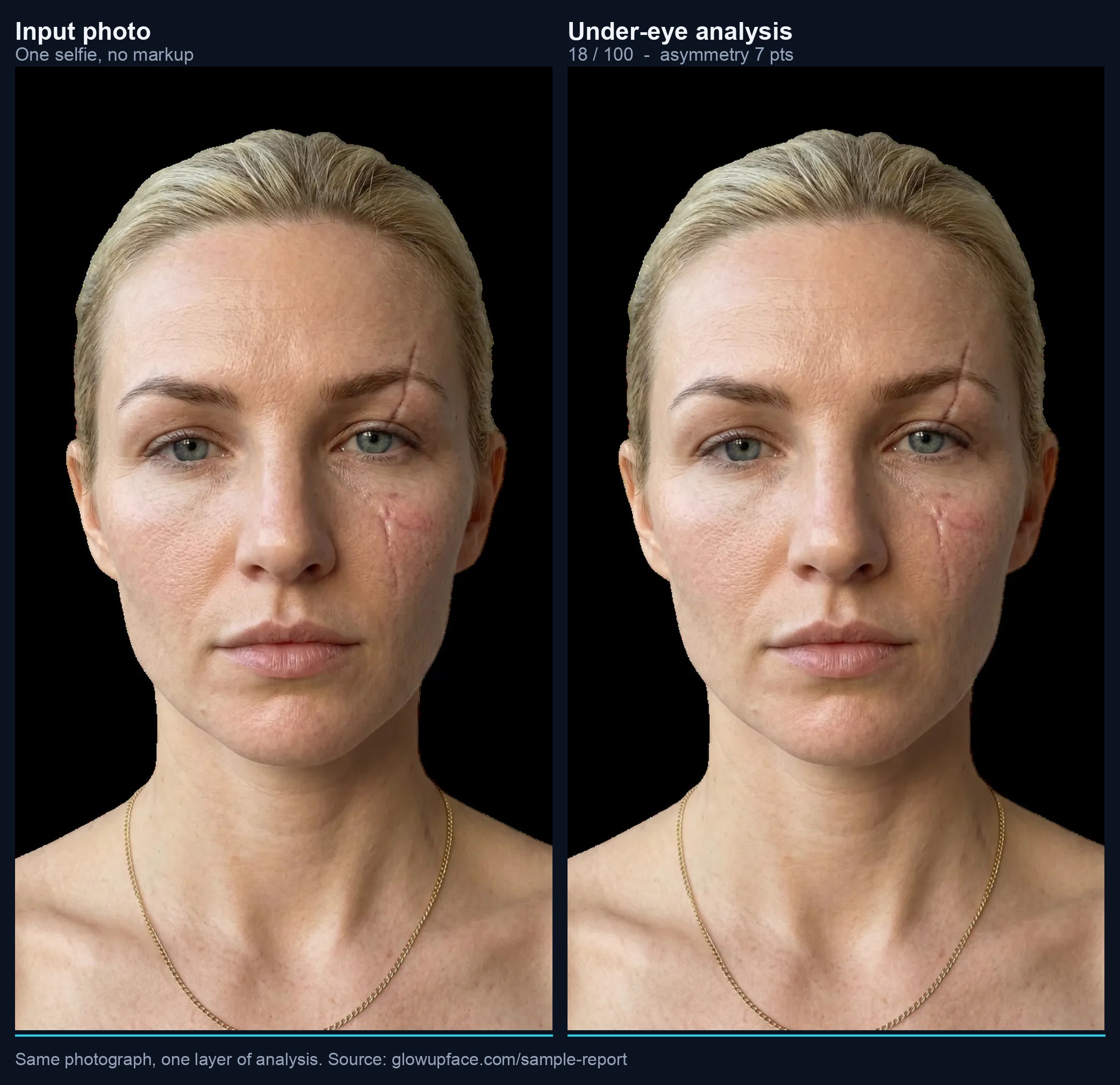
On that one photo, the engine scores under-eye darkness at 18/100 with 7 points of left/right asymmetry, comparing brightness against a per-eye cheek reference. That is a real, repeatable measurement — of appearance.
It is not a measurement of body water, and this is precisely where the chain breaks. Sarkar and colleagues' review of periorbital hyperpigmentation lists the established causes: genetic and constitutional pigmentation, excessive pigmentation, post-inflammatory hyperpigmentation secondary to atopic and allergic contact dermatitis, periorbital oedema, excessive vascularity, and shadowing from skin laxity and the tear trough with age. The review does not list dehydration. Sundelin's data add sleep deprivation as a cause of under-eye darkening (b = 7.2 mm). No source in this literature links under-eye darkness to fluid status at all.
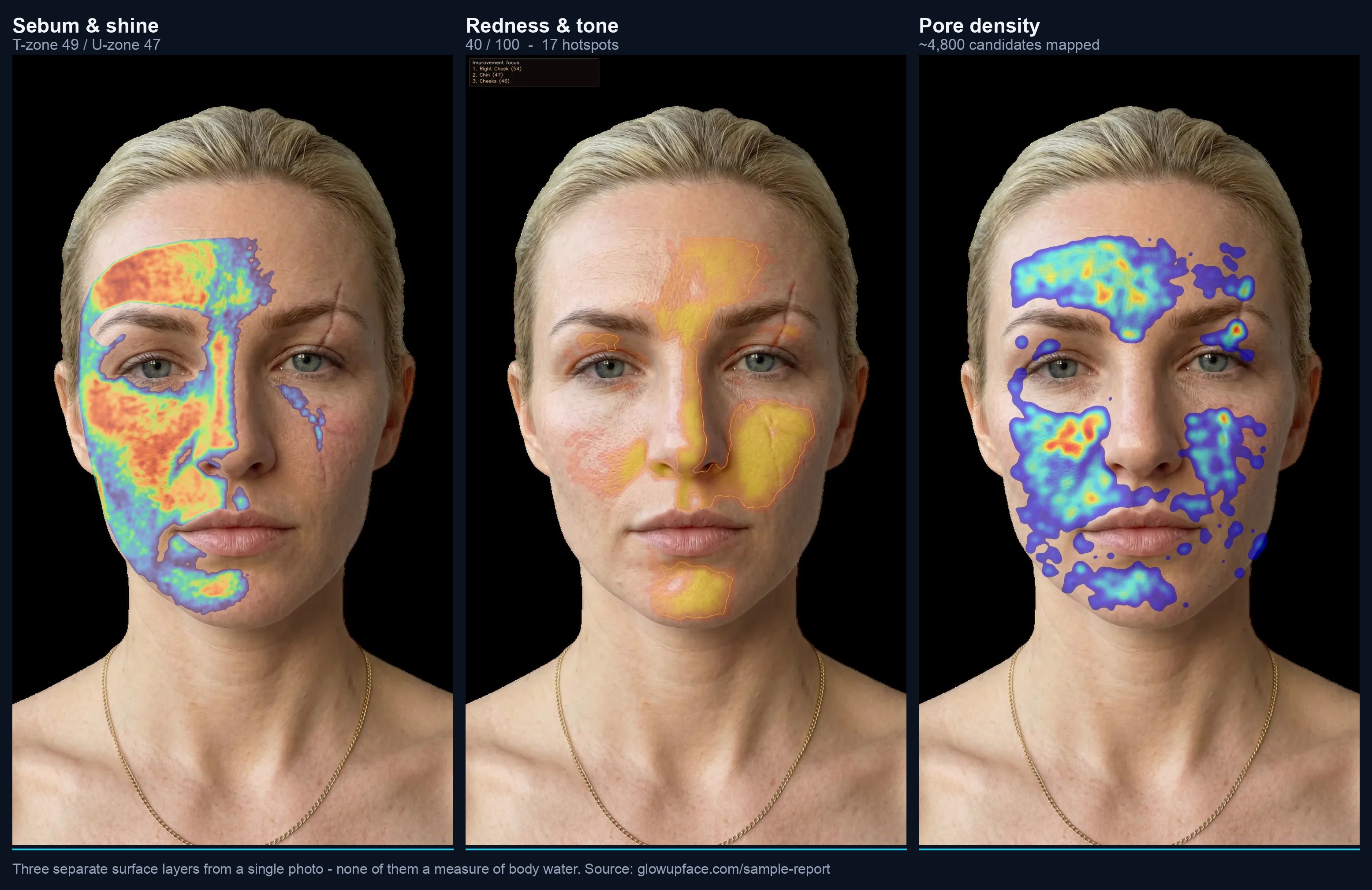
The same holds across the other layers. Sebum distribution separates the T-zone from the U-zone; a redness map locates vascular hotspots; a pore-density field maps surface texture. Skin blood colour does carry information about perceived health — Stephen and colleagues had participants manipulate colour-calibrated facial photographs along measured oxygenated and deoxygenated blood-colour axes, and they raised skin blood colour, particularly oxygenated, above basal levels to optimise healthy appearance. But that is a finding about perception and skin perfusion, not a hydration assay.
So the ceiling is clear, and it is the same ceiling for the eye and the algorithm. A camera can tell you that a face is shiny in the T-zone, red on the right cheek, and asymmetric under the eyes by seven points. It cannot tell you how many litres are missing. Anyone who wants to see what that class of analysis does and does not claim can read our explainer on the tool; it reports skin-surface properties, and it tells users to see a dermatologist rather than treating the output as a diagnosis.
What can't we tell from a fighter's face?
Plainly, so no one quotes this article for more than it holds:
- Nobody has measured skin hydration, skin elasticity, transepidermal water loss or facial appearance in a combat athlete during an actual weight cut. Every physiological figure above is borrowed from marathoners, aerobically trained cyclists, haemodialysis patients and a water-intake trial run entirely in women — populations that differ from a mostly male fight roster in ways nobody has quantified.
- The two MMA cohorts here are professional mixed martial artists, not specifically UFC rosters. The weigh-in and rehydration mechanics are the same; the promotion is not the sampled unit.
- The one large diagnostic test of visible dehydration signs covers 2–3% losses in runners. Fight-week cuts are several times larger and have never been tested this way.
- No published work links under-eye darkness, facial redness or skin shine to body-water status in anyone.
- Sleep loss and a full camp's energy deficit produce much of what viewers attribute to dehydration, and no imaging method separates those contributions.
- None of this supports a claim about any individual fighter's health from a photograph. That inference is exactly what the evidence here rules out.
The useful takeaway is narrower than the folk version and more interesting. The drained weigh-in face is real, and it is mostly telling you about a hard week rather than about litres. The rebound is real too, and it is mostly telling you about volume rather than about recovery. And the one thing everyone believes they can read off it — how dehydrated he is right now — is the one thing neither an eye nor a camera has ever been shown to measure.
Sources & further reading
Peer-reviewed studies and primary data behind this analysis.
- Jetton et al.: dehydration and acute weight gain in MMA fighters (europepmc.org)
- Maurício et al.: structured weight management in MMA (www.frontiersin.org)
- McGarvey et al.: clinical signs of dehydration in endurance athletes (europepmc.org)
- Goehring et al.: measures of skin turgor, systematic review (europepmc.org)
- Menne et al.: regional skin water loss during haemodialysis (europepmc.org)
- Palma et al.: dietary water, skin hydration and biomechanics (pmc.ncbi.nlm.nih.gov)
- Fernandez-Elias et al.: muscle water and glycogen recovery (doi.org)
- Sundelin et al.: cues of fatigue after sleep deprivation (pmc.ncbi.nlm.nih.gov)
- Sarkar et al.: periorbital hyperpigmentation review (pmc.ncbi.nlm.nih.gov)
- Coetzee et al.: quantifiable visual cues to weight (europepmc.org)
- Stephen et al.: skin blood perfusion and perceived health (pmc.ncbi.nlm.nih.gov)
Put the data to work
Compare any two fighters head-to-head, or see what our AI predicts for upcoming UFC fights.
More from the MMA Lab
What Happens When a UFC Champion Misses Weight Before a Fight?
What happens when a UFC champion misses weight? Learn who can win the belt, why title fights allow no extra pound, and how fines and catchweights work.

Did UFC Early Weigh-Ins Reduce Weight Misses? The Data
UFC early weigh-ins give fighters more recovery time, but a 247-event study found more weight misses. See what changed and what the data cannot prove.
Does Fight-Night Weight Regain Help UFC Fighters Win?
Does UFC fight-night weight regain improve win odds? Compare 1,474 MMA weigh-ins, 616 UFC athletes, and conflicting evidence on size and recovery.
Do UFC Fighters Who Miss Weight Win More Often? What Data Says
Do UFC fighters who miss weight win more often? UFC audits show why raw win rates, favorite status and fight-night size point to no stable advantage.